
Say Hello to the Largest Legal Aid Provider in Australia
It isn't Legal Aid.
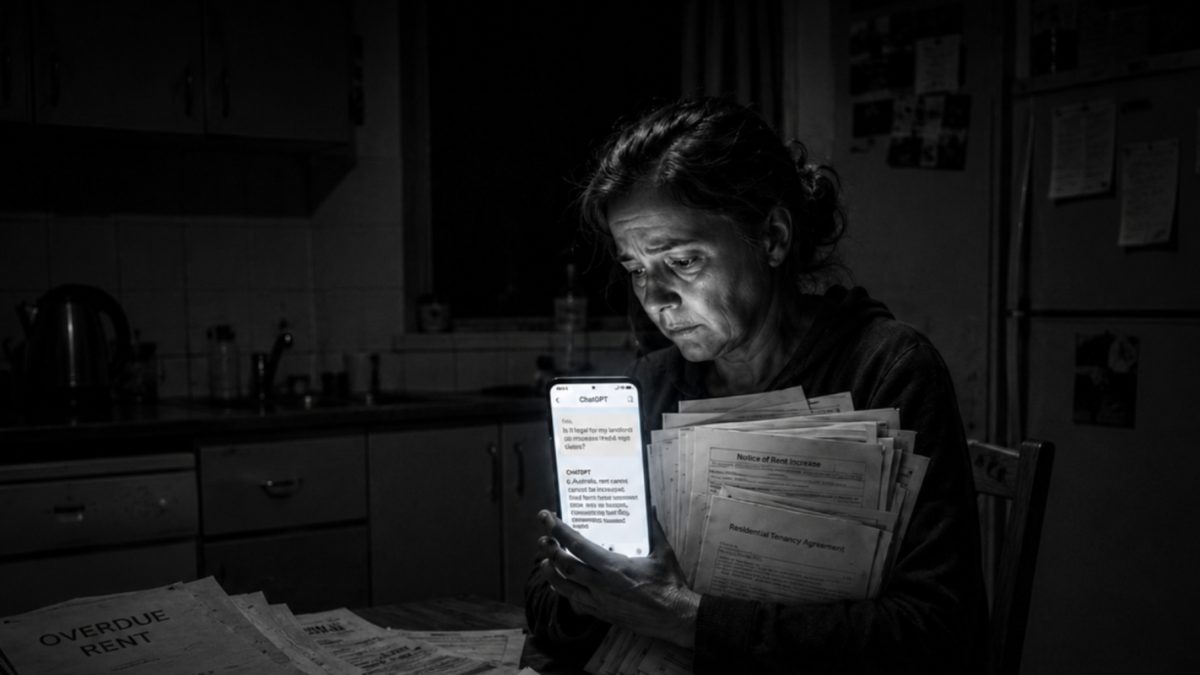
The letter at 2am
Someone gets a letter from their landlord and it is the middle of the night, and they don't know if it is lawful. They don't know their rights. They can't afford a lawyer, they don't qualify for legal aid, and the community legal centre closed hours ago. The community legal centre is always closed at 2am, which turns out to be most of the hours in which people are frightened.
So she asks ChatGPT whether her landlord can put her rent up mid-lease. And ChatGPT answers. It explains the legislation, cites the right Act, tells her no, this doesn't look right, and drafts a letter she can send.
The information is correct.
What ChatGPT doesn't know is that she signed a fixed-term lease with a clause that permits the increase. It doesn't know she's three weeks behind on rent, or that the landlord has been hunting for grounds to evict her for months, and that the moment she sends that letter he escalates, because he has better advice, more money, and has been waiting for exactly this.
The information was right. The help would have been: don't send that letter. Not yet. Show me the lease first. Tell me what you're actually trying to protect, because I don't think it's the rent.
She didn't go to a lawyer. She went to ChatGPT, at 2am, for free, because she couldn't afford a lawyer and didn't know she needed one.
The profession calls this a risk. She calls it the only help she got.
The middle of Australia has no lawyer
There are two legal professions in this country and you already know which one you're in.
The first serves people who can afford $400 to $600 an hour. They get a lawyer, they get advice, they get representation, they get someone in the room fighting for them. The system works for these people because the system was built for these people.
The second serves people who qualify for legal aid, and even then it's a maybe. They might get a lawyer. They might get thirty minutes with a duty lawyer who is meeting them for the first time. They might get advice but not representation. They might be told their matter lacks "sufficient merit," a budget decision doing its very best to pass as a legal assessment.
Between those two professions is a gap, and around 80% of the population is standing in it.
Fewer than 8% of Australian households are eligible for legal aid. Only about half the people living below the poverty line qualify. The Productivity Commission has said, in the politest possible institutional language, that even comfortably middle-income Australians can't really afford a lawyer if something serious goes wrong. Welcome to the middle. Mind the gap. It's been empty a while.
This is the cohort that falls through every crack there is: middle-income earners, sole traders, small businesses, families. Too much money for legal aid, not enough for a private lawyer, and, this is the part people miss, not enough knowledge to know that the problem in front of them is a legal problem in the first place. So they self-represent and usually lose, or they walk away from their rights altogether and call it bad luck.
Not poor enough for free. Not rich enough for the fee.
None of this is new. The profession has known about this gap for decades. The Productivity Commission named it, the Law Council named it, National Legal Aid named it, every access-to-justice report for twenty years has named it, and nobody filled it. The profession made itself so inaccessible that a chatbot in the middle of the night started to feel more useful than a lawyer most people couldn't afford, couldn't find, and didn't know they needed.
So this is an article about why that happened, and what the profession should do about it.
So they asked ChatGPT
When we ask whether AI is entering the legal profession, we are asking the wrong question. It is already inside the access-to-justice system. It entered through the gap.
Say hello to the largest legal aid provider in Australia.
Not officially, obviously. There is no funding agreement, no service charter, no minister who will stand next to it for a photo. And to be precise about it: ChatGPT is not legal aid in the legal or institutional sense. Legal aid means advice, representation, a duty of care, a regulated professional on the other side of the desk. ChatGPT is none of that. That is precisely the problem. It is being used as legal aid, at scale, by people who have no other door to walk through.
Measured crudely, by the sheer number of people who needed legal help and got something, the largest provider in the country isn't Legal Aid, isn't the community legal sector, and certainly isn't private practice. It's a chatbot.
For the 92% of Australians who aren't eligible for legal aid, this is the first time anyone has answered the question. The first time the legal system has been reachable at 2am in Dari. The first time someone hasn't had to take a day off work to sit in a waiting room and be told their problem is "outside our scope."
The answer might be wrong. It might hallucinate a provision that doesn't exist, miss a nuance that changes everything, hand someone confidence in a position that's legally incorrect.
But it might also be right. It might tell someone, in plain language, what the letter actually means and whether the landlord can do what the letter says and what the options are. It might be the difference between panicking all night and knowing enough to call the right service in the morning.
And this is the thing the profession keeps refusing to sit with: the alternative to imperfect AI information was never perfect legal advice. The alternative was nothing. AI is serving the people the profession was never reaching. The 80% didn't leave their lawyers for a chatbot. They never had a lawyer to leave.
The profession's response to all this has been: "AI can't practise law." Which is true, and which is also an answer to a question nobody is asking. The question is not whether AI can practise law. The question is what happens when millions of people use it as if it does, because the profession never built anything for the moment they needed help and couldn't afford it.
ChatGPT has not become the lawyer. It has become the front door to legal help for people the profession never built a door for. Hold onto that, because it is the whole argument.
The danger is not wrong information. It is incomplete help.
Let me be honest about something, because the easy version of this argument is dishonest.
AI is good at legal information. Genuinely, properly good. Ask ChatGPT to explain residential tenancy law in Victoria and you'll get a competent, clearly structured, largely accurate overview. It'll find the right legislation and use the right terms and explain the process in plain language, in any language, at any hour, for free, with no waitlist, no intake form, and no one making you feel stupid for asking.
What it can't reliably see is the line where legal information turns into legal judgment.
It can't see the priority sitting behind the question. It doesn't know that the person asking about a rent increase is really asking how to keep her children housed. It doesn't know the employment question is really about whether someone can afford to resign without ending up homeless. It doesn't know the family law question is sitting inside coercive control. It doesn't know that the legally correct next step might be the humanly dangerous one.
That's the difference between information and help. Information tells you what the law provides. Help tells you what to do next given your facts, your risk, your power position relative to the other side, your documents, your deadlines, your safety, and what you're actually trying to achieve, which is often not the thing you asked about.
So the harm here is not really that AI gets things wrong. The danger isn't the obviously wrong answer. The obviously wrong answer is almost safe, because something in it usually feels off. The danger is the almost-right answer that sounds completely usable.
AI doesn't always know which state's law applies, so it blends jurisdictions. It hallucinates cases that don't exist but sound exactly like cases that do. It drafts clauses that are perfectly standard and completely wrong for the specific situation in front of it. It gives confident advice without the context that changes the advice entirely.
And the person reading it can't tell, because they don't know enough law to know what's missing. That's the whole problem. Polished text feels correct even when it isn't, and AI writes very polished text.
Research suggests people overestimate two things at once: the quality of the AI's legal advice, and their own grasp of the issue. So ChatGPT tells someone they've got a killer case, and they walk into a lawyer's office pre-loaded with confidence in a position that doesn't hold, and the lawyer spends the first hour of the consultation dismantling something instead of building something. That's the good outcome. The bad outcome is they never see a lawyer at all, because the AI told them they didn't need one.
Here's the part that should keep the profession up at night.
The people relying on AI for legal advice are not going to turn up at your office afterwards to be corrected. Not because they're stubborn, but because they don't know they got it wrong. They don't know the jurisdiction was off. They don't know the clause doesn't apply in Victoria. They don't know they needed a lawyer, because as far as they're concerned they had one. It was free, it answered at 2am, it sounded sure of itself, and it didn't make them feel stupid for asking.
So the correct response is not to fight this. It's not to ban it, and it's certainly not to lecture the public about why they shouldn't use the only thing that answered them. The correct response is to be a little bit grateful that something finally stood in the gap the profession left empty, and then to build the thing that makes it safe.
A disclaimer protects the company. A warning protects the person.
Before going further, the strongest counterargument deserves a straight answer. Imperfect information, the objection runs, can be worse than no information at all. No information at least keeps people cautious. Bad information makes them confident, and confidence is what moves them. The woman with the fixed-term lease is the proof. Silence would have kept her still, and the answer is what sent her forward into the thing that hurt her.
That objection is correct. It is not, however, an argument for prohibition, because you cannot ban the 2am answer. It is already in everyone's pocket. All you can actually decide is whether it arrives with a warning or without one. The choice was never AI or lawyers. It's AI that knows its own limits versus AI that doesn't, and right now only one of those is being built.
Because right now, consumer AI tools do not reliably tell you when to stop and go and see a lawyer.
ChatGPT doesn't say "this sounds like it involves family violence, please contact a specialist service before you act on anything here." It doesn't say "this lease question turns on your specific circumstances, and a community legal centre will review your lease for free." It doesn't say "you're describing an unfair dismissal, but a fixed-term contract can change everything, so see a lawyer before you file." It just answers, confidently, fluently, and lets you act on it.
"This is not legal advice," sitting in grey text at the bottom of the page, does nothing for the woman about to send a letter that triggers an eviction notice. It does nothing for the father about to reject a parenting order because a chatbot told him he had a killer case. It does nothing for the tenant about to miss a deadline or breach an order because the AI sounded sure and the fine print felt like it was for someone else.
Disclaimers protect the tech company. Warnings protect the person who is scared and tired and alone at 2am. They are not the same thing and the profession should stop letting them be confused for each other.
A warning has to land at the exact point of risk, not as a ritual sentence tacked onto the end of the conversation. It has to interrupt. It has to say, in plain words: stop, this is the moment your specific circumstances start to matter, and before you send that letter or file that application or walk away from that offer, show the lease to a real person, call this number, talk to someone who can see what I can't. Because right now the system hands people just enough rope, and then washes its hands with a disclaimer.
Why the middle was never built
So why didn't the profession build something for the middle itself, in all those decades it spent naming the gap?
Because the middle doesn't make money. That's the unglamorous answer and it's the whole answer.
Private practice runs on high fees, because high fees cover overheads and salaries and partnership draws and profit. The fee isn't a barrier to the product. The fee is the product. Serving the middle means cutting the fee, and cutting the fee means cutting revenue, and the model simply doesn't have room for that.
Legal aid runs on a capped government allocation. It can't stretch to cover the middle because it can't even stretch to cover everyone already inside its own eligibility threshold. And it's worth being precise about this: legal aid isn't underfunded by accident. It's underfunded because properly funding access to justice for everyone who needs it would cost more than any government has ever been willing to find.
Community legal centres are the closest thing to a middle that currently exists, and they're held together with grant funding, project funding, and the goodwill of people who are tired. They take whoever walks through the door with whatever resources they happen to have that quarter. They're also chronically understaffed and unable to meet the demand already in front of them. The sector needs something in the order of an extra $240 million just to meet existing need, and roughly a third of the private practitioners still doing legal aid work are thinking about leaving within five years, because the pay no longer makes sense.
So there is no economic model for the middle anywhere in the system. Private practice can't serve it profitably, legal aid can't serve it within its funding, CLCs can't serve it at scale, and so it doesn't get served.
To be clear, none of this means AI should be treated as a lawyer, because it shouldn't. Legal advice is regulated for good reasons. A lawyer carries duties a chatbot will never carry: competence, confidentiality, professional judgment, conflict management, candour to the court, and actual accountability when something goes wrong. AI can't replace that and shouldn't pretend to. But repeating "AI is not a lawyer" does not conjure a lawyer for the person who can't afford one, can't reach one, or doesn't know they need one.
Regulation marks where the boundary sits. It does not, on its own, build anyone a bridge across it.
Other jurisdictions are building the bridge
Here's the part that matters most, because it answers the objection that always comes next, that this is all too hard and can't really be done. It can. Other countries have looked at the same mess and, instead of holding another panel about innovation, started testing things. Different things, imperfect things, occasionally slightly terrifying things. But actual things. Three of them, roughly: new business models, AI governance, and public-facing triage.
New business models. The United States looked at this gap and decided to test whether the profession's own monopoly was the problem. In 2020 Utah opened a regulatory sandbox that let non-lawyers hold stakes in legal businesses and let technology do work that lawyers had always kept to themselves. Arizona went further and simply scrapped the rule that only lawyers could own a law firm. Five years on, more than a hundred alternative business structures are operating, and they've delivered services to hundreds of thousands of middle-income people, the sole traders, the families, the small businesses, who would otherwise never have seen a lawyer. The consumer complaint rate is almost too small to plot: under 0.01%. The sky did not fall. People in the middle just, finally, got help they could afford. It isn't a clean story. Utah has tightened entry since, because some models didn't scale the way anyone hoped, and Arizona is still adjusting its oversight. Good. That is what experimentation looks like when it is real and not a panel discussion with muffins. The direction of the data is not in dispute: stop protecting the profession, start protecting the public, and the gap begins to close.
AI governance. The United Kingdom went at it through the technology itself. In July 2025 the Ministry of Justice released an AI Action Plan for Justice, not a list of warnings but a deliberate strategy to build AI into courts, tribunals, legal aid, and public-facing services. The judiciary updated its guidance for judges in October 2025 and was candid about both the risk and the opportunity. It's unfinished and some of it is still experimental, but the governance layer is being built in public view, rather than left to whatever Silicon Valley decides to ship.
Public-facing triage. Citizens Advice in the UK put triage tools on its website to route people toward the right help before they act on half an answer. Australia has its own version: Justice Connect built an AI-powered triage tool that turns ordinary language into legal-issue detection and routes people toward the right service. A handful of CLCs and firms here offer genuinely unbundled services. But all of it is fragmented and underfunded and tiny against the scale of the need. It proves the model works. It also proves how far there still is to go.
The profession's posture is starting to shift, at least near the courts. In April 2026 the Federal Court released its Use of Generative Artificial Intelligence Practice Note, the first comprehensive national statement of its kind, and it openly acknowledges that AI carries real potential for efficiency, lower cost, and better access to justice. New South Wales has had practice notes since early 2025, Victoria issued new Supreme Court guidelines in May 2026, and the Victorian Law Reform Commission tabled a report in February 2026 with thirty recommendations for safe use in courts and tribunals.
These are real steps and they deserve to be called that. But they're still reactive, and they're still aimed inward. They govern what happens inside a proceeding, once a person is already in the system. They do nothing for the 80% standing in the gap at 2am, the people who have never seen the inside of a courtroom and never will, right up until the moment the AI advice goes wrong and puts them there.
Build the layer between information and advice
So that's the proof that this can be done. The harder question is what doing it here would actually involve.
Start with what AI is genuinely replacing, because it isn't the lawyer. It's the thing the lawyer never built: the first conversation, the moment a person discovers their problem has a legal name, the bridge between "I can't afford help" and "I'm now in court," the answer at 2am, the question asked in Dari, the explanation that doesn't make someone feel stupid. The profession left that space empty for decades and AI walked into it. The honest move now is to stop treating that as a threat and start treating it as the chance to finally build the access the profession always said it cared about.
And it doesn't require solving every access-to-justice problem at once. It requires building the one missing layer between general information and actual legal advice. Every public-facing legal AI tool should be able to do three things.
One. Name the legal issue. Not just answer the question, but name the kind of problem the person is in: tenancy, employment, debt, family violence, immigration, discrimination, child protection, consumer law, criminal law, or something else entirely. Most people in the gap don't lose because they got the law wrong. They lose because they never knew their problem had a legal name at all.
Two. Flag the risk. The tool should recognise when a person should not be acting on information alone. Where there's violence, eviction, children, police, a court deadline, an immigration consequence, debt enforcement, the end of a job, disability, coercive control, or any decision that can't be undone, the tool should stop handing out confidence and start handing out caution. It should know when to stop talking. "This sounds like it might involve family violence. Before you act on anything here, please contact 1800RESPECT." A warning inside the conversation, at the moment it matters, not a line of cover buried in the terms of service.
Three. Connect the person to human help. Not a vague disclaimer, not "seek legal advice" buried at the bottom of the screen, but a real referral at the moment it matters: which service, in which state, at what level of urgency, what to bring, what to say on the phone, and what not to do before they've spoken to someone. The person who asks ChatGPT at 2am should be sitting in front of a lawyer by 10am, not because they decoded the system themselves, but because the system connected them.
That's the bridge. Not AI pretending to be a lawyer, and not lawyers pretending AI is going to go away. A working layer between the answer a person gets at 2am and the judgment they need before they act on it. Done well, it makes the lawyer's job easier rather than harder, because the client arrives understanding the shape of their problem instead of certain of a position that won't survive contact with the facts.
And here is the part that cannot be delegated. This is not a job for tech companies alone. The profession should be defining the red flags, the escalation points, the referral standards, the jurisdictional boundaries, and the minimum warnings that any public-facing legal AI tool must carry. Law societies, courts, legal aid bodies, community legal centres and government each hold a piece of this. The profession knows where the line between information and advice sits, and knows what goes wrong when that line gets crossed. That knowledge belongs inside the governance, not in a press release filed from the sidelines while the gap fills itself with harm. If the profession does not write these rules, tech companies that don't understand law, or government departments that don't understand practice, will write them instead.
What AI finally makes possible
And once that bridge exists, something larger comes into reach. The thing the profession arguably should have built decades ago, and couldn't, because the economics never allowed it. The middle. AI is what makes the middle affordable enough to be real.
There's unbundled legal services. Not full representation for everything, but a menu, where the client buys only the part they need. A document reviewed? Pay for the review, not a retainer. One specific question answered? Pay for the question, not an ongoing engagement. Representation at a hearing? Pay for the hearing, not the six months of correspondence in front of it. AI does the research and the drafting; the lawyer does the judgment; the client pays for the judgment. The price falls from thousands to hundreds, and the middle becomes something a firm can actually serve.
There's AI-assisted triage at the front door: what is happening, how urgent is it, does this need a person, and where should they go next. If it needs a person, it routes them to the specific service for their specific issue. If it doesn't, it gives them the information in plain language, in their language, with a clear account of when to escalate. Not a general intake line. Not a maze. A route.
There are community-embedded legal workers. Not lawyers waiting in legal aid offices for people who already know to come, but workers placed where people actually are: schools, hospitals, Centrelink offices, settlement services, community centres, mosques, temples, churches. People who can spot a legal issue before it becomes a crisis, give basic information, and hand the person on to a lawyer at the right moment. AI gives those workers instant access to legal information, template documents, and triage tools. The worker is the human. The AI is the infrastructure standing behind the human.
And there's legal information treated as public infrastructure rather than a professional monopoly. Funded the way public health information is funded: plain language, genuinely accessible, delivered where people already are, available in every major community language and pitched at the reading level and trust level of the real population. Not a substitute for lawyers. A foundation, so that people know their rights before the day they have to enforce them.
The choice
Because the alternative is just the thing already happening: millions of people making legal decisions on the strength of AI that sounds right, looks right, and is wrong in ways they have no way to detect.
The profession is about to watch the gap between information and help play out in real time, across an entire population at once. Some people will be fine, the simple problems, the clear-cut rights, the matters where the information genuinely is the help. But the complicated ones won't be, and the complicated ones are the ones that involve power, fear, coercive control, cultural complexity, competing obligations, money running out, children, disability, immigration status, trauma. Those are exactly the situations where information without help is dangerous. And they fall, overwhelmingly, on the people least likely to have a lawyer waiting to catch them when the AI gets it wrong.
You cannot ban the 2am answer. The only thing left to decide is whether it arrives with a warning or without one.
The profession left the gap empty for decades, and something finally stood in it. The only real question now is whether the profession helps build the bridge, or keeps debating, from the sidelines, whether the bridge is a threat.
Note
This article is general information only and is not legal advice. It does not take into account your objectives, circumstances or jurisdiction, and should not be relied on as a substitute for advice from a qualified lawyer. If you have a legal problem, you should obtain independent legal advice from a suitably qualified legal practitioner or community legal service in your state or territory.