
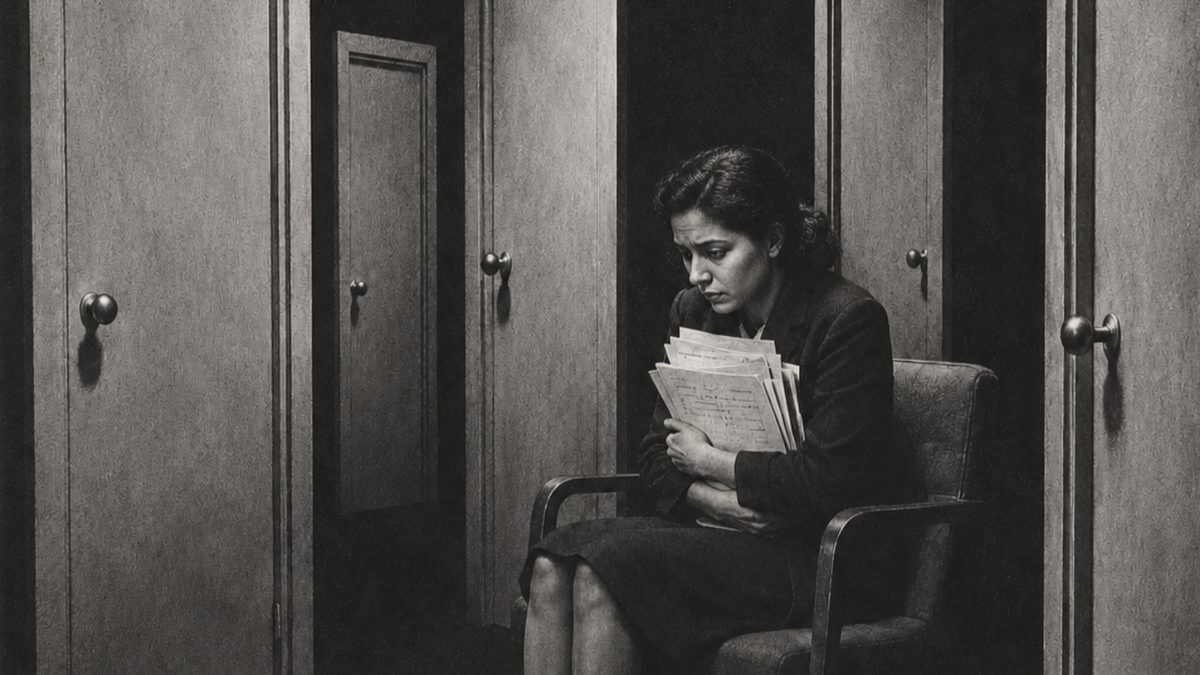
You know that thing where everyone in a room agrees something needs to change, and then everyone leaves and absolutely nothing changes? That's coordination, or at least that's what we keep calling it.
Every national strategy for the last twenty years has named it as the fix. Every royal commission, every sector reform, every inquiry has said the same thing: we need services to work together. Everyone nods. Everyone signs the MOU. Everyone agrees it's obvious.
And then a woman walks into a family violence service. It took her forty minutes and three glances back at the door before she could speak. She tells the worker everything, the violence, the pattern, the immigration fear, the cultural pressure, the exact thing he said last Tuesday that finally made her leave.
The worker listens with her whole heart, documents it carefully, makes the referral, and follows the framework she's been trained to follow. She does everything right.
Then the lawyer says, tell me what happened. She tells it again from the beginning. Child protection calls: can you tell us what's been happening? Again. Housing: again. By the fourth telling she's flatter, shorter, skipping details she couldn't skip the first time. She sounds less distressed.
A woman who stops crying halfway through the fourth intake can start to look, on paper, like a woman whose risk has reduced. The system looks at the file and scores her as lower risk. It is not lower risk. It is retraumatisation.
Some women stop coming altogether. The file says client disengaged. It doesn't say the system asked her to relive her worst day as proof until the help cost more than the harm. And we never count the ones who stopped coming.
I keep thinking: every single one of those services had signed the MOU. Every single one had access to the information-sharing framework. Every single one was, on paper, coordinated. The referral was made. The pathway was followed. She still had to start again.
So what exactly did we build?
The Thing We Keep Mistaking for Coordination
There are two kinds of coordination. The sector has spent twenty years perfecting only one of them.
Structural coordination is organisations agreeing to work together: MOUs signed, referral pathways mapped, governance groups established, terms of reference approved, databases built, flowcharts drawn, acronyms multiplied until the sentence itself needs a support worker. It looks great in reports. It satisfies funders. It photographs well at signing ceremonies. It gives everyone something to point to when the inquiry asks what has been done.
Practice coordination is the one that actually matters: did the right knowledge reach the right worker before she was asked to bleed her story again?
I know that sounds dramatic. But if you've ever sat across from someone who has just told the worst story of their life for the fourth time this week, you know it's not dramatic. It's Tuesday.
If the client still has to begin again, the system has not coordinated around her. It has arranged itself around its own paperwork.
The family violence worker knew things that would have completely changed the legal advice. Not the headline facts, those usually travel. What disappears is the meaning-making layer: why she's scared of police, why leaving could affect her visa, why family pressure is operating as a risk factor, why a legal option that looks protective on paper may actually make her less safe in practice.
Every retelling erodes trust. She told the first worker because she trusted her. She told the second because she was told to. By the third she's performing. By the fourth she's editing, leaving out the parts that still hurt too much, the parts she's started to feel ashamed of.
Our risk assessment tools were built for the first telling, the raw one, the shaking one, the one with tears. Not the fourth. The fourth telling looks like coping. It is not coping.
In coercive control, this fragmentation doesn't just fail her. It can actively protect him. The Australian Institute of Health and Welfare calls this systems abuse: perpetrators learn to manipulate services and systems to continue exerting power and control. They present differently to each service. They know the family violence worker's notes don't reach the family court. They know child protection's assessment doesn't include what the settlement worker observed. The fragmentation is not just a coordination failure. It is a vulnerability the perpetrator can exploit.
Coercive control is only visible across time and context. A single intake can't see it. Six intakes that don't talk to each other can't see it either.
We count referrals. We never count what the referral cost her.
The Worker Never Finds Out
And here's the part that gets me: the family violence worker who did everything right never found out what happened. She doesn't know if the lawyer received what she knew. She doesn't know if the advice accounted for the cultural context she spent an hour learning. She sits with the outcome, or the absence of one, without a feedback loop.
She did her job. And then silence.
Workers who complete referrals and never learn the outcome carry that not-knowing as a cumulative weight. The sector wonders why it can't retain people. This is part of why.
The system didn't fail because coordination was missing. It failed because coordination stayed on paper.
Why We Keep Building the Wrong Thing
The research on this is brutally clear. And the sector has mostly chosen to look the other way.
Jody Hoffer Gittell spent two decades studying coordination across healthcare, aviation and other high-interdependence sectors and named what makes the difference. Her theory of relational coordination proposes that highly interdependent work is most effectively coordinated through relationships of shared goals, shared knowledge, and mutual respect, supported by frequent, timely, accurate, and problem-solving communication.
Read that again. Not databases. Not MOUs. Not co-location. Relationships of shared goals, shared knowledge, and mutual respect.
Gittell's research distinguishes this from the kind of coordination carried out primarily by managers at the top of functional silos. Relational coordination is carried out via direct contact among workers at the front-line, through networks that cut across functional boundaries at the point of contact with the person being served.
That is the layer Australia has barely funded.
An MOU can tell people they are allowed to work together. It cannot make them understand one another. It cannot make a lawyer know what a family violence worker sees before the legal issue becomes visible. It cannot make a child protection worker understand why a survivor's inconsistency might be the most consistent evidence of coercive control in the file. It cannot make housing understand that safety is not a future planning issue when a woman has nowhere to sleep tonight. It cannot make trust appear between workers who have never had enough funded time to speak unless something has already gone wrong.
That part has to be built deliberately.
And here is the uncomfortable bit. The motivation for coordination in any system tends to be highest among the people closest to the person it's meant to serve, the worker sitting with the woman who desperately needs the other service to know what she knows, and lowest at the governance levels where the coordination is actually designed.
We are building coordination where nobody is motivated to use it. And ignoring the level where everyone is desperate for it.
The Models Already Exist: people have figured this out
This is not unsolvable. That's the part that makes it worse, actually. People have solved it, not perfectly but well enough to show us that we're choosing not to.
Victoria's Orange Door was the most resourced attempt in Australia. They put workers from different services in the same building. Logical, right? If the problem is that people don't talk to each other, put them in the same room.
It helped some. Warm referrals improved. But relational coordination didn't automatically follow. Nobody articulated why putting people in the same building would make them share what they know. They assumed proximity equals collaboration. It doesn't. Anyone who has ever worked in an open plan office already knew this.
New Zealand built something different. Their Family Violence Act 2018 introduced information sharing laws to allow the family violence sector to collect, use and disclose personal information for purposes related to family violence, requiring agencies and practitioners to consider sharing information if it may help protect a victim.
And then they did the thing most governments skip. They funded the layer underneath the law.
In 2021, the cross-agency Joint Venture released Te Aorerekura, the 25-year National Strategy to Eliminate Family Violence and Sexual Violence, which recognises that sustained and coordinated effort is needed to address the underlying drivers of violence and create lasting change. The strategy is structured around six shifts, explicitly including workforce development and integrated cross-agency practice, with implementation supported through successive action plans.
The point is not that New Zealand has solved this. They haven't. The point is that the strategy names workforce, practice culture and cross-agency capability as their own funded shifts, rather than treating them as things that will somehow appear once the structural reform is announced.
Canada named the problem explicitly. Their 2024 federal progress report on the National Action Plan to End Gender-Based Violence said the quiet part out loud: as of 2023 to 2024, 50 targeted services have become available to survivors of intimate partner violence, including independent legal advice, legal representation, legal navigation, and comprehensive wraparound supports. These services aim to reduce retraumatisation when survivors engage with the justice system.
Read the framing carefully. Not improve access. Not streamline referrals. Reduce retraumatisation.
They named what we keep dancing around: the retelling itself is the harm. Build the alternative.
None of these models are perfect. Even in Canada, advocates have flagged that funding has not consistently reached community-based services on the ground and that the National Action Plan needs to be expanded and fully funded for 10 years to have the impact intended. All of them have implementation challenges and contexts that don't translate directly. But they share something the Australian system mostly doesn't: they invest in the relationship layer underneath the structural layer. They fund the phone call. They fund the person whose job is to make sure what one worker knows reaches the next worker before the client arrives.
The fix everyone reaches for first (and why it doesn't quite work)
I know what you're thinking. Why don't we just put everything under one roof? One organisation. One intake. One team that holds the legal, the housing, the child protection, the family violence, and the cultural support. She never retells because she never leaves.
It sounds perfect. It's not. Or more precisely, it's not the fix for the reason you think.
No one organisation can hold every specialisation well. The family violence service can't also be a law firm. The legal service can't also be a housing provider. The moment you try to do everything, you do most things at a lower quality than the specialist would. She gets one intake, yes. But she also gets a generalist lawyer instead of a family violence specialist lawyer, and a generalist housing worker instead of someone who knows the local waitlists.
And wraparound organisations become gatekeepers. If you're their client, you get everything. If you don't fit their intake criteria, you're back to the six-service model. The wraparound works beautifully for the people inside it. Everyone else is still retelling.
So if the answer isn't one organisation that does everything, and it isn't co-location alone, what is it?
It's the function, not the structure. One person holds the story. One person coordinates. One person makes the phone calls, does the briefings, closes the loops. That person doesn't have to work at a wraparound organisation. They can sit at any service and do the coordination function across services.
That is the layer New Zealand actually funded. Not a super-organisation. A coordination function. A person whose job is to make sure the woman's story travels with its full human context regardless of how many services she touches.
You don't need to merge the services. You need to connect them at the practice level. The specialisation stays. The quality stays. What changes is that someone is funded and responsible for making sure what one worker knows reaches the next worker before the client arrives.
Not a new building. Not a mega-service. A person. A phone call. A relationship that exists before the crisis does.
Why Australia keeps choosing the paper version
Here is the part that matters, and the part nobody in the sector wants to put in writing.
Since the 2016 Royal Commission into Family Violence, the Victorian Government has invested more than $3.7 billion in family violence reform, more than every other state and territory combined, and has reported the implementation of all 227 recommendations from the Royal Commission.
That is not a small number. That is not a token effort. That is the largest sustained investment in family violence reform in Australian history, by a long way, by a government that took the Royal Commission seriously.
And the woman still told her story six times.
This is the bit that should keep us up at night. The argument is not that Australia hasn't tried. The argument is that the investment went where it could be measured.
A signed MOU is a deliverable. A new intake hub is a ribbon-cutting. A statewide rollout is a milestone. These things can be reported up. They can be audited. They can be put on a slide for the Minister. They demonstrate, in language a funder understands, that something has been built.
The forty-minute phone call where one worker translates a survivor's situation into language another worker can act on does not appear anywhere. There is no field in the data system for it. There is no funding stream that pays for it. There is no KPI that rewards it. If anything, the time it takes counts against the worker, because her billable hours are lower that day.
So we end up with a system where the thing that actually coordinates care is invisible, unfunded, and quietly punished, and the thing that performs coordination is visible, funded, and celebrated.
This is not a failure of intention. The people designing these systems are not stupid. They are responding rationally to what they are being asked to demonstrate. The problem is what we are asking them to demonstrate.
We ask: have you built coordination?
We do not ask: did she have to start again?
Until those are the same question, we will keep building the wrong thing.
What coordination around her would actually look like
If we built coordination around the survivor instead of around the paperwork, here is what would be different. None of this is hypothetical. Every element of it exists somewhere already.
She would tell her story once, in full, to the worker she chose to trust. That worker would carry the story forward, not as a referral note, but as a person who stays in the loop until she is safe or has chosen to disengage. The story would travel with its meaning intact: the immigration fear, the cultural context, the exact thing he said last Tuesday, the reason she's flinching at the police option even though on paper it looks protective.
The lawyer would not ask her to begin again. The lawyer would ask her what she wants to add, what has changed, what she wants the legal response to do. The lawyer would already know the shape of her situation, because the worker who knew it would have made sure of that, and would have been paid to do so.
Child protection would arrive having read the family violence worker's notes and the settlement worker's observations together. They would understand that her inconsistency across previous tellings is the texture of coercive control, not the absence of credibility. They would know that the perpetrator presents differently to each service because that is what perpetrators of coercive control do. They would treat the gap between his presentations as evidence, not as confusion.
Housing would understand that safety tonight is a different question from safety planning, and the question tonight is the one being asked.
And the family violence worker, the one who did everything right and then sat in the silence, would find out what happened. She would know whether the legal advice landed. She would know whether the cultural context she spent an hour learning made it into the room where the decisions were made. She would have a feedback loop, because without one she is being asked to care without being allowed to learn.
This is not a fantasy. New Zealand funds part of it. Canada names part of it. Victoria built the building for part of it and then didn't fully fund what had to happen inside the building. Every component exists somewhere. We have just never put them in the same place at the same time and called that the system.
A note on consent, because anyone working in this sector will be thinking it. None of this means careless sharing. Consent under coercive control, immigration fear, or institutional power imbalance is never simple, and the practice layer has to honour that complexity rather than hide behind a tick-box. The systems doing this well don't reduce consent to a signature. They build the worker capability to navigate it well, in context, in the room, with her. That capability is part of what needs to be funded.
The question underneath all of this
The structural coordination exists. Nobody is asking you to tear it up. The MOUs can stay. The frameworks can stay. The databases can stay.
But they are not enough. And the sector knows they are not enough. Every worker in the room knows they are not enough.
The sector keeps asking: how do we improve coordination?
The woman is asking something much simpler: why do I have to keep telling you?
If she still has to start again, what was the coordination for? Not what was it called. Not what does it say in the MOU. Not what appears in the annual report. What was it for. Whose experience was it designed to change, and did it change it.
If the answer is that it was for the funder, then it worked. If the answer is that it was for the inquiry, then it worked. If the answer is that it was for the photo, then it worked.
If the answer was supposed to be her, then it didn't.
And we will keep producing women who walked into the room, told the truth, were carefully documented, correctly referred, and asked to start again on Tuesday, until we are willing to fund the part of the system that nobody photographs.
The worker is still waiting to find out what happened.
That silence is the system.
It is paperwork that believes it is safety.
If you work in family violence, legal services, child protection, housing, settlement, or frontline support, I’ve built a free practitioner resource: The First Handover, Volume 1 of The Lejacie Handover Method.
It includes the scripts, the briefing structure, and the lawful-basis prompts for transferring context so a person does not have to start again.
Download it at lejacie.com.