
On Monday, the Prime Minister was asked about a royal commission into violence against women.
He said: "What does a royal commission do, besides fund lawyers?"
He said: "We know what's required here. We know that there's too much violence against women. We know what keeps women in these relationships."
He said the government has committed more than $4 billion.
And in the four days before that interview, four women were killed.
Twenty-nine women and nine children so far this year.
By advocacy counts, more women were killed by gender-based violence in 2024 than in any year since 2015.
The rate of women killed by an intimate partner rose 28% in 2022-23, a sharp turn upward after three decades of decline.
Police are called to a family violence incident every minute. Almost double the rate in 2016.
The money was spent. The laws were passed. The reforms were built.
By the count of the advocates who track these deaths, more women are being killed now than at any point in the last ten years.
And then the six words that have been sitting in my chest since Monday: "We know what's required here."
"We know what's required." "We know what keeps women in these relationships." "We know."
"We know" is the most dangerous sentence in this conversation.
If you know, and they are still dying, then knowing is not the thing that saves them.
Australia keeps converting women's deaths into recommendations, recommendations into funding announcements, funding announcements into programs, and programs into annual reports.
You know that feeling when you walk into a building and there's a sign on the wall that says "Your Safety Is Our Priority" and you think, good, someone's handling it?
That's how reform works in this country.
Someone dies. A coroner investigates. A review finds systemic failures. A government announces funding. A new agency gets a name and a logo. A campaign launches with a hashtag and a colour. Everyone shares it. Everyone wears the ribbon. The Prime Minister says "national crisis" on camera.
And then someone else dies.
And the coroner investigates. And the review finds systemic failures. And the government announces funding.
You know this cycle. You've watched it. You might even work inside it.
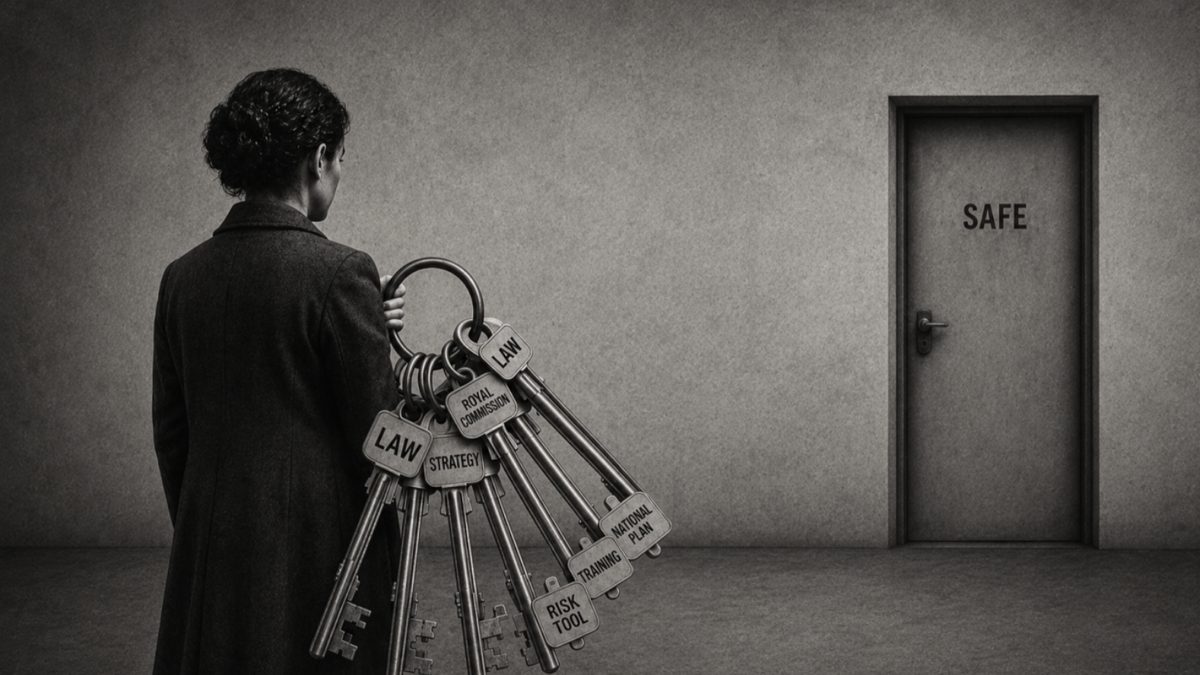
Here is what the cycle has produced. Laws. Frameworks. Strategies. Services. Risk tools. Information-sharing schemes. Crisis payments. Training modules. Prevention campaigns. National plans. Coercive control legislation. Cross-examination bans. A $5,000 leaving violence payment. 500 additional community workers. More than $4 billion in federal commitment. More than $3.8 billion in Victoria alone. 227 recommendations accepted from the Victorian Royal Commission into Family Violence. Every single one. South Australia's Royal Commission made another 136; the state accepted 129 of them.
The problem is not that Australia has built nothing.
It has built a lot.
And still, women are being killed.
That is the uncomfortable part.
The problem is not Royal Commission versus no Royal Commission. The problem is that Australia keeps mistaking knowledge, funding and recommendations for actual safety.
Where the danger gets through
The problem is that the reforms keep fixing the sign on the wall instead of fixing the room.
I need to say something carefully, because I know people who work inside this system. Good people. Exhausted people. I work alongside them. I deliver child safety education to multicultural communities. I know what the inside of this system smells like. It smells like smoke.
The people inside it are not the problem. They are standing in rooms that are on fire, carrying caseloads that would break most people, and watching the gap between the reform and the room get wider every year.
The problem is that the system keeps building things that can be announced. And stops before building the things that make them work when she walks through the door.
Let me show you exactly where the danger gets through. Not in the abstract. Through real people, real cases, real gaps the reform did not close.
We criminalised coercive control. Good.
But the police who respond to coercive control calls often cannot recognise it, because coercive control does not look like a bruise. It looks like a woman who seems fine. It looks like a man who is polite and reasonable at the door. It looks like "she seems a bit emotional" in the officer's notes. The law exists. The training to use it is patchy, inconsistent, and often a half-day workshop competing with seventeen other priorities.
Hannah Clarke's friend called the police. She said she was scared for Hannah. They told her they could only act "if he did something." He did something. He doused her car in petrol on the school run and set it alight. Aaliyah was 6. Laianah was 4. Trey was 3. Hannah died that evening. The coroner found every agency failed to recognise the risk, because he "had not been violent" in the way the system was trained to see. He controlled what she wore. Who she spoke to. How she spent her time. None of it left a bruise. Her death drove the coercive control laws. We built the law because of Hannah. We did not build the capability to use it.
We banned perpetrators from cross-examining their victims in family court. Good.
But only after 173 women were cross-examined by their abusers over a two-year period. The ban only applies in certain circumstances. The family court still treats domestic violence as a factor to weigh rather than a pattern to interrupt. A mother who is terrified of her ex-partner still navigates a process designed for two reasonable adults dividing assets, not for a woman whose safety depends on the outcome. The cross-examination ban fixed one symptom. The architecture that produced it remains.
We built risk assessment frameworks. Good.
But the tools assume the victim can accurately report her own danger. A person who has been systematically taught over years that her experience isn't real, that she's overreacting, that it wasn't that bad, is not going to check "high risk" on a form. Minimising isn't a communication failure. It's what prolonged abuse trains you to do.
Research found that only 47% of femicide victims accurately predicted their own risk before the lethal event. Half of the women who were killed did not see it coming. Not because they were naive. Because coercive control distorts your ability to assess your own danger. The tool was designed for a victim who can clearly articulate the level of danger she is in. That person has been methodically trained not to exist.
We built a bail system with charges, conditions, and AVOs/IVOs. Good.
But the system that assesses his bail risk and the system that assesses her safety do not talk to each other. Nobody is required to tell her the decision has been made.
Molly Ticehurst was 28. A childcare educator. A mother. He had been charged with raping her. Stalking her. Intimidating her. Killing her puppy. He was granted bail on a weekend. Two weeks later Molly was found dead in her home. She died because the bail decision was made in one room and her safety was managed in another, and nobody connected the two before he arrived at her door.
We built protection orders. Good.
A national scheme, enforceable across state borders. But a protection order assumes the person it is designed to stop will be stopped by paper. For the perpetrator who is escalating, the order is not a barrier. It is confirmation that she told someone.
In 40% of cases where a woman was killed by a partner, she had a protection order. Kelly Thompson spoke to police many times. He regularly breached the order. Nobody treated the breaches as evidence the danger was increasing. He stabbed her to death in her home. She did not die because the system hadn't given her a protection order. She died because the system treated the order as the protection. It was not the protection. It was a document.
We built a policing response. Good.
But a woman's third call to the police is not necessarily treated with more urgency than her first.
Kelly Wilkinson called police at least three times. A protection order was issued. Her ex-partner was arrested and charged. Nine days later he was released. He set her on fire in front of her three children. The assistant commissioner said: "We've had too many wake-up calls." She did not die because nobody had heard her. She was heard. Three times. She died because being heard by the system and being protected by the system are not the same thing.
We built information-sharing frameworks. Good.
MOUs between services. Risk protocols. Referral pathways. But building the framework does not mean the information flows. Six services can all have signed the MOU and still not call each other. The perpetrator learns the fragmentation. He presents differently to each service. The silos are not just a coordination failure. They are a vulnerability he can exploit.
Rosie Batty had intervention orders. Police contact. Her son Luke's father had four outstanding arrest warrants. Charges hadn't been authorised due to "workload issues." Nobody put it together. In February 2014, Greg Anderson killed eleven-year-old Luke with a cricket bat at a suburban cricket oval. Rosie told the inquest: "I was hoping someone was going to step in and help me protect Luke and take some weight off my shoulders." Nobody stepped in. Her grief drove the Royal Commission. 227 recommendations. All accepted. More than $3.8 billion. And in 2026, the woman still tells her story six times.
We built a national reform framework. Good.
But we built it primarily by and for mainstream, English-speaking, urban populations.
First Nations women are 34 times more likely to be hospitalised because of family violence, and six times more likely to die from it. In intimate partner homicides with a known history of family violence, 1 in 4 female victims killed by a male partner were First Nations women. Between 1989 and 2023, 460 First Nations women were killed. No downward trend. Sophie Quinn was a First Nations woman in Lake Cargelligo. In January 2026, she was allegedly killed by her former partner, along with her unborn child, her aunt Nerida, and her partner John. You cannot build a universal system by designing it for one population and calling it universal.
We built hotlines, websites, brochures, payments, and pathways. Good.
But we built them for a woman who speaks English fluently, has secure immigration, understands the legal system, has independent finances, has somewhere to go, trusts the police, and arrives at the exact moment the system is ready. That woman does not exist.
We built services. Good.
Crisis accommodation. Legal aid. Community workers. But women and children escaping violence make up 40% of the clients of homelessness services. Those services turn away 350 people every day. An extra $240 million is needed just to end the existing legal aid shortfall. The $5,000 leaving violence payment assumes she has left, or has a plan to leave. But the decision to leave is itself a risk assessment, not a financial calculation. Will he find me. Will he kill me. Will child protection take my children. The services were built. They were not built at the level required to meet demand.
That woman does not exist. Nobody arrives at the exact moment the system is ready. They arrive at 2am, or on a Sunday, or in a language nobody on shift speaks, or with a story that contradicts itself because trauma doesn't produce clean narratives, or terrified that reporting will get them deported, or after the fifth time they called and nobody came.
When the real woman shows up, the room doesn't say "we weren't designed for you." It says "why didn't you report sooner?"
Every case I've described fails at the same point. The system built the thing that can be announced, funded, measured, and reported. And stopped before building the thing that makes it work when the real person shows up.
Hannah: the coercive control pattern was there in front of everyone. The training to recognise it was not.
The ban on perpetrators cross-examining victims was built, but only after 173 women had already been cross-examined by their abusers, and the family court architecture that produced the problem was never redesigned.
Risk assessment tools exist. They just assume a woman can name her own danger, when 47% of femicide victims could not, because the tools were built for a person coercive control has spent years training out of existence.
Molly: the bail system worked exactly as designed, and the part that should have reached her safety simply did not connect to it.
Kelly Thompson had the protection order. What she did not have was a response to the breaches. Kelly Wilkinson had the police contact, three times over, and not once the capacity to act on it.
With Luke, the information existed across every agency in the state; the requirement to assemble it did not exist anywhere.
Sophie had a reform that was real and a reform that was never designed for her community. The services were there. They turn away 350 people a day.
Every time. The top layer was built. The last metre, the implementation of it was not.
- The law without the training.
- The court ban without the redesign.
- The risk tool without the capability to read the real person.
- The bail decision without the safety connection.
- The order without the safety assessment.
- The policing without the capacity.
- The referral without the handover.
- The service without the funding to meet demand.
- The prevention without the sustained investment.
And because the system measures what it built, not whether it reached her, it cannot see the gap. It reports success. She is not safer.
When a plane crashes, we don't say: "Pilots have manuals, so we already know what to do."
We investigate the chain. Which warning was missed. Which handover broke. Which alarm was ignored. Which design made failure more likely.
We investigate because something that was meant to prevent death did not prevent death.
Femicide should be treated the same way. Not as a private tragedy. Not as another awareness campaign. As a preventable systems failure where the black box is scattered across police records, court files, hospital notes, housing waitlists, school concerns, and the things women told people before they died.
In almost every case, someone in the system knew something. The pieces were in different rooms. Nobody was required to put them together. By the time they were assembled, it was in a coroner's report. Not a safety plan.
Who designed it differently
This is not unsolvable.
That is the part that makes it worse.
No model is perfect. No country has eliminated male violence. No system should be copied blindly.
But other jurisdictions have built pieces of the last metre that Australia should be studying seriously.
Other countries have started building the part Australia keeps skipping. The part between the announcement and the room.
New Zealand named collaboration and workforce capability as part of the family violence architecture, not something that would magically appear after the law passed. Its Family Violence Act requires decision-makers to collaborate where appropriate to identify, stop, prevent and respond to family violence. Its national strategy recognises workforce and organisational capability as part of the reform itself. The lesson is simple: do not pass the law and hope practice catches up. Build the practice layer.
The UK built MARACs because high-risk domestic abuse cannot be managed by one agency holding one fragment of the story. Police, health, housing, probation, children's services and specialist domestic abuse workers come together around high-risk cases to share information and plan safety. The model is not perfect. But the design insight matters: homicide risk lives in the pattern, and the pattern has to be assembled before the funeral.
Spain built VioGén, a national risk-monitoring system for reported gender-violence cases, linking risk levels to police protection measures. Spain has not solved femicide. VioGén has been criticised, including for cases where risk was underestimated. But the principle is important: risk cannot sit in scattered files and still be called a safety system.
NSW has started building one piece of the last metre with DV Notify, a service that alerts victim-survivors about custody status and release. It is not glamorous. It does not sound like a national transformation strategy. It sends the warning before he arrives. Sometimes the last metre is not a new framework. It is the text message that reaches her before he does.
Canada's national work is useful because it names wraparound support as a design question, not just a compassion question. Survivors should not have to be retraumatised every time they touch the system. Canada has implementation gaps too. But naming retelling as harm is already further than systems that call six intakes "access."
None of these models is perfect. None has ended male violence.
But they share something Australia keeps treating as optional: they build the connective tissue. The person. The phone call. The shared risk picture. The release notification. The coordinated safety plan. The workforce capability underneath the law.
They do not just build the announcement. They build the part that reaches the person.
What built all the way to the front door looks like
I am aware of the irony of ending an article about the failure of recommendations with recommendations. We have plenty of those. But the difference between a recommendation that fails and one that works is whether it describes what to announce or what to build.
So here is what "built all the way to the front door" actually looks like.
It looks like an officer who arrives at 2am and recognises coercive control without a bruise in sight.
Not because he did a half-day workshop three years ago. Because he has ongoing, supervised training with case review, and his sergeant asks him what he saw in the pattern, not just whether there was an injury. It looks like a policing system where 500 domestic violence calls a day is treated as core business. Where the specialist unit stays funded because saving women's lives is not a pilot program.
It looks like a family court that treats domestic violence as a pattern to interrupt, not a factor to weigh alongside property and parenting schedules.
A redesigned process that understands a woman's safety may depend on the outcome. And a risk assessment that does not ask the victim to accurately predict her own danger when the violence has spent years training her not to. Where the worker has been taught to read minimisation as evidence. Where the woman sitting calmly in front of her may be at the highest risk in the room.
It looks like a bail system where the moment he is released, she knows.
The family violence worker knows. The risk assessment is updated. Before he arrives at the door. It looks like a protection order where every breach triggers a new risk assessment, not a new piece of paper. Where someone asks, before the order is issued, whether this order will make her safer or more exposed. In her community. With his pattern.
It looks like enough beds, enough lawyers, enough crisis accommodation, enough workers.
Funded at the level required to meet demand, not the level that fits in the budget. 350 people turned away every day is not a resource gap. It is a choice.
It looks like a reform designed with Indigenous communities.
Not consulted after the framework is built. In the room where the design happens. With funding that lasts longer than the trust takes to build.
It looks like a phone call between the family violence worker and the lawyer before the referral lands.
Where the next worker already knows the cultural context, the immigration fear, what not to make her repeat. Where the referring worker finds out what happened. Because a referral without a feedback loop is a message in a bottle.
It looks like prevention education in her language. Delivered by someone her community trusts.
Funded as infrastructure, not a 12-month project that ends before the relationship matures. It looks like a reporting pathway that does not require police as the first step, because for some women, police contact is more dangerous than the violence. It looks like someone sitting in a room with a mother who has just arrived in this country and explaining, in her language, what the law means for her child. Not a pamphlet. A person.
None of these are new ideas. Every one has been recommended before. The question is whether this time we build them all the way to the front door.
We know. We knew after Rosie. After Luke. After Hannah. After Molly. After Kelly. After Kelly. After Sophie. After every coronial inquest that found the same systemic failures and made the same recommendations and watched the government accept them and watched the numbers go up.
We are still building the sign on the wall.
It says all the right things.
She can't read it from where she's standing.
Note
This article provides general information, commentary and analysis based on publicly available data and advocacy reports at the time of writing. It is not legal advice and should not be relied on as a substitute for independent professional advice tailored to your circumstances. While care has been taken to use credible sources and current statistics, datasets on family and domestic violence are continually updated and different organisations use different definitions and counting rules. Any errors are unintentional, and responsibility for interpretation of the data and views expressed rests solely with the author. If this content raises concerns for you, please seek specialist legal, social support or counselling services in your jurisdiction.