
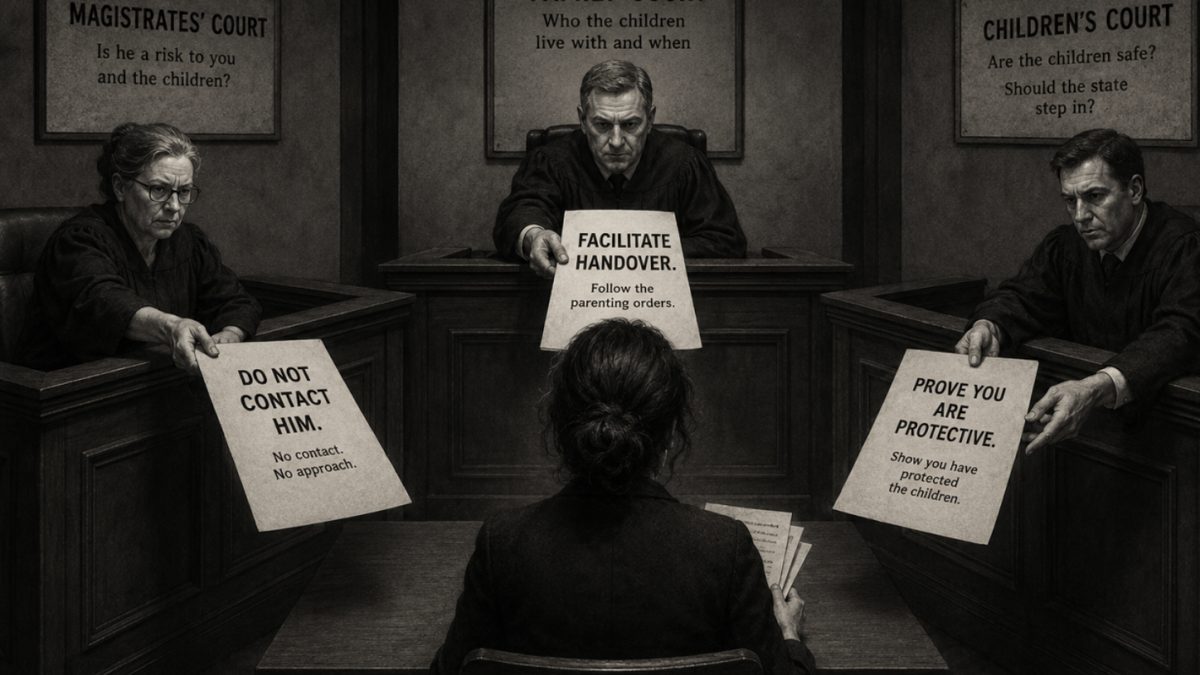
It's Tuesday morning.
At 9am, she has to be at Magistrates' Court for a hearing about the interim intervention order. She has a letter from Family Court, demanding she respond to his parenting application by Friday. Yesterday, child protection called and they'll be coming over to check if her kids are safe.
She's been up since 4am, staring at court documents that make her head spin. School drop-off for the kids is at 8:45, but there's no after-school care anymore. She just can't afford it since she left him. In the past two weeks, she's burned through three days of unpaid leave for court dates. Her boss warned her: one more, and she might not have a job.
It's been five weeks since she left. She did what you're meant to do. She got the order. She got the kids somewhere safe. She's said yes to every system that's told her to show up.
Now she's tangled in three courts at once.
Court One: Magistrates' Court
This is where her family violence intervention order lives. She asked for it right after she left. They gave her an interim order. Now she waits on a hearing to make it final. The magistrate has questions: Should he be allowed to contact her? Come by the house? Show up at the kids' school? The whole point here is: is she at risk, and what does she need to be protected?
Court Two: Family Court
Here, it's all about the kids and who gets them and when. He's filed for shared parental responsibility. He wants equal time. Claims he's a good dad. Says the violence went both ways. Accuses her of poisoning the kids against him. His lawyer is sharp. He looks calm and collected in court. He comes off well.
The Family Court (officially the Federal Circuit and Family Court of Australia, but everyone just calls it Family Court) asks a different question: what's best for the kids? Even after the 2024 reforms ditched stuff like the "meaningful relationship with both parents" mantra and the automatic assumption of equal shared parenting, the tug-of-war between protecting kids from harm and keeping up each parent's relationship with them is still right there in law and in every courtroom.
Court Three: Children's Court
Now child protection has jumped in. Because the kids saw the violence, they're investigating if she's a "protective parent." Did she take steps to protect her children? Is her new place safe? Is she doing all the things the system asks?
Here, the court wants to know: are the kids at risk, and should the state step in?
Three courts. Three questions. Three sets of lawyers. Three different legal codes. Three different judges or magistrates, and odds are, they'll never talk to each other about this family.
What We Keep Calling a "System" and Isn't
There are two types of accountability running through all this, though only one actually exists.
Jurisdictional accountability? Each court owns whatever happens inside its walls. Magistrates' Court handles the family violence order. Family Court handles who sees the kids. Children's Court deals with state protection. Each court has its own judge or magistrate, rules, and appeals. Each one, on its own, is doing what it's supposed to. The machinery works.
Human accountability? That's someone being responsible for what happens to her as it all collides. That doesn't exist. No court, no bailiff, no legal form covers it. No protocol even hints at it. She's the only person forced to make the three worlds fit together, even though she has no power to dictate how. One way or another, she'll break an order and she just has to hope it's not the wrong one.
So here she is, trying to keep her kids safe, obey the intervention order, follow the parenting rules, please child protection, make all the right appointments, scrape up the money for lawyers she can't afford, and hang onto her job that's slipping away with every court date. All while three arms of the state each tug her in a different direction.
This isn't a theory problem. The contradiction is alive, right in the paperwork.
Magistrates' Court says he can't come near her or the kids. Family Court says she has to let the kids be with him. That handover, when the kids go from one to the other, puts both grownups in the same place at the same time.
She simply can't follow both orders.
If she shows up for the handover, she breaks the intervention order. If she keeps the kids home to obey the intervention order, she breaks the parenting order. If she breaks the parenting order, his lawyer will shout "parental alienation." If she's found guilty of that, she might lose her children.
Nothing in the system forces the courts to fix these cross-cutting demands before dropping them in her lap. So she has to navigate the mess and pay the price if she gets it wrong.
This isn't just some rare "edge case." It's actually one of the most-reported failures in Australian family law. The Royal Commission into Family Violence called it out. So have countless reviews and lawyers and social workers. But nothing's changed: she alone is still required to make the impossible make sense and live with the fallout.
Luke Batty died at the center of this contradiction.
His mother, Rosie Batty, had an intervention order. But there were old parenting orders too and his dad still had access. On one hand, the law told Rosie the man was dangerous. On the other, it demanded she let him see Luke. The coroner found Rosie was confused about the orders, and even the professionals around her didn't get it. Different agencies and different courts were all involved, but nobody saw the big picture.
Luke died at an access visit, required by one set of rules and forbidden by another.
Now, the same woman being asked by child protection if she's a "protective parent" is right back in Rosie's shoes, with no map and no actual power to resolve anything.
If you've been around this space, you already know her. You've seen her slumped in the waiting room, drifting off mid-sentence, apologizing for needing your time while every part of her life (housing, safety, her kids) is up in the air. What looks like "disorganization" is just someone stretched past her limit. This isn't just her story. It's yours, too.
She can't afford a lawyer
She can't afford a lawyer and sometimes because the system decides she can't have one.
Can't afford counsel for all three cases. Legal aid has tight rules: maybe she squeezes in for one case, maybe he does for another, but they'll never fund both sides in the same matter. The system's just not funded for what's really going on.
And when she does get legal aid and he pays for his own lawyer, the gap stays wide. He strolls into court prepped and coached for every hearing. She pulls all-nighters, barely comprehending the paperwork through exhaustion and trauma.
The court sees a calm man and a frazzled woman. It assumes he's stable and she's not. But really, it's just preparation versus collapse.
Meanwhile, he can keep filing new applications for as long as he likes. Every one drains her money, time, and emotional reserves. Court delays? They're not neutral and they're ammo for him, but cost her everything.
She was told not to tell
She's got evidence of violence and things that would change how Family Court sees the risk.
But her lawyer told her to stay quiet.
The game is familiar and fast: the moment she raises it, they'll say she's fabricating stories just to cut him out. And the research backs it up: even when women allege family violence, judges in the Family Court often expand the kids' time with the alleged perpetrator.
Coercive control isn't neat or simple; it leaves stories that are messy and inconsistent and things courts don't like and don't trust.
So she keeps quiet. Because people who know the system told her that telling the truth could actually get her punished.
The system that was supposed to listen to her has made it dangerous to speak.
Nobody has a map
Nobody has a guide for this. There's no handout explaining: here's how all three courts interact, here's what to do about clashing orders, here's who has real power, here's who you call when nothing lines up.
The reason is simple: the system itself doesn't know what happens when the pieces don't fit. Each court stands on its own. She's the only one told to stitch the puzzle together.
Rosie Batty told the inquest she didn't understand how it all worked. She never should have had to. No one should be required, while in crisis, parenting scared, traumatized, to synthesize three separate legal regimes.
This is not unsolvable
The fix? It's been on the table for years, in every royal commission, review, and lawyer's lunchroom.
What she needs is simple: One court. One process. One person who can see the family violence order, the parenting order, and the child protection file all at once, and make choices that work in real life.
The Law Reform Commission said exactly that in 2019. Every jurisdiction's experts told the inquiry that s68R (an existing law that lets one judge fix contradictions in orders) is almost never used. Not because the power isn't there, but because nobody is trained to invoke it, nobody shows survivors how to ask for it, and the system isn't set up to track where family violence and parenting decisions meet in the first place. The ALRC recommended spelling it out in the law, prompting it on forms, training every magistrate. Most of those recommendations are still stuck somewhere in a report or a committee.
We've had the diagnosis since 2010. We know what to build. But still, today, a woman on Tuesday morning is holding papers meant for systems, not for lives, with nobody joining the dots for her.
Why? Because the people who'd have to fix this are clear on what would really work, but they're holding onto power. Courts don't just hand over control. State and federal governments don't rush to combine budgets and ministries. The same systems that make three courts run on one family also fund and feed three bureaucratic silos.
What looks like confusion is really a preference for keeping things divided.
Other places have already built this bridge
New York did it back in 1996. One judge, one family, all three streams (criminal, family, and protection) heard together in the same court. They called it an Integrated Domestic Violence Court. They evaluated it, and it worked. Better safety. More people actually following the rules. Cheaper, too. The proof has been sitting there for almost thirty years.
New Zealand took a different path. They passed the Family Violence Act 2018 and changed their Care of Children Act at the same time, so those two parts of the law actually had to work together. Not just suggested. Required. They wrote the bridge right into the law.
Scotland went even further. Their Domestic Abuse (Scotland) Act 2018 made coercive control a course-of-conduct crime. They also built a system where protection orders and family orders get heard in the same court, on the same issues.
England and Wales didn't dance around it. In 2021, they said exactly what the problem was and put it in black and white. They passed a law to stop perpetrators from gaming the courts and no more filing endless applications just to wear her down. Australia still doesn't have anything like that.
Nobody here had to reinvent the wheel. Each country simply decided the real contradiction was the state's job to solve, not hers.
Australia looked at the same problem and chose a different answer.
Why Nothing Changes
Since 2016, Victoria has spent over $3.7 billion on family violence reforms and more than ever before. Every one of the Royal Commission's recommendations is marked "implemented." Still, she's in three courts.
This isn't about nothing getting built. It's about where the money went. New courthouse? Ribbon-cutting. Specialist court list? Press release. Cross-agency meeting? Minister's speech. Those are investments that can be counted, announced, displayed in annual reports.
But the thing that would actually change her Friday (the small, simple mechanism to fix the contradiction) doesn't show up in any government dashboard. Nobody pays magistrates for taking the extra ten minutes to check both kinds of orders. Duty lawyers aren't rewarded for making the call before 9am. If something can't be photographed, funded, or ticked off on a spreadsheet, it gets left behind. That's how we end up with reforms that make ministers happy and systems powerful and she still has to live with the contradiction, every day.
That's not a criticism of the people inside it. Most of them already know what needs fixing. It's a criticism of the incentive structures they're working inside.
What happens if we finally get it right
We're not short on solutions. Every fix already exists, just not collected in one spot, working together. What's missing is a system built around her, not around court boundaries.
Here's what a better Tuesday morning looks like.
She still has a 9am hearing. But now, the magistrate reviewing her intervention order already knows about the parenting case in Family Court. Not just a quick summary but a real look at both applications, flagged for conflicts.
Her family violence duty lawyer is there, already looped in with the child protection worker. They've talked. They know her situation (her immigration worries, why the safe room matters, what last Tuesday looked like). She isn't asked to repeat herself. Someone is making sure information flows.
Any orders that come out today won't contradict the parenting order. The magistrate, using powers under s68R of the Family Law Act (that have always existed), updates the parenting order right there, to avoid the impossible trap. Today, that authority is used, because the magistrate is trained and she knows to ask.
Now, questions like "Can he do school pickup?" and "Is he a risk to the kids?" aren't answered in two different courts. Someone holds both pieces at once.
Child protection isn't running a third parallel process. Instead, their findings come to the same judge, who weighs everything (consistency, risk, parenting) together. If her story about the abuse changes, it isn't seen as proof she's lying, but as the mark of coercive control and trauma.
She's not alone in this. Maybe she has a lawyer, a support worker, or just someone whose whole job is to keep her story moving with her. No "do-everything" mega service, just a real person making sure she doesn't have to start from scratch every time.
Now, school pickup happens without her standing in a car park, sweating over whether she's breaking a law just by being present. Orders line up and the handover is supervised, or arrangements are thought out ahead of time. She isn't forced to improvise when it's too late.
She's still in court. That's real. But this time, the court holds the big picture. She doesn't have to carry it alone.
It's what every frontline worker wants. What every royal commission recommends. What ministers describe as "complex" before shelving, yet again, the only fix that matters. The woman on Tuesday is waiting for someone to finally bring that solution into the light.
If you work in this world (duty lawyer, family violence worker, child protection officer) you know the feeling. You're sitting across from her, holding information you legally can't use. You know everything, but your hands are tied. You watch her walk out with papers that conflict, knowing she'll have no answers by Friday. That feeling doesn't go away. It stacks up, week after week. And maybe that's why it's so hard to keep talented, caring people in these roles.
So, she stays in three courts.
She's the only one with the whole picture, juggling it on top of hearings, school runs, filing deadlines, and a job slipping away one court date at a time.
Everyone asks, "How do we coordinate the system?"
But she's asking something simpler.
Which order do I obey on Friday?
She needs the answer for Friday and not for the next review, royal commission, or working group. That answer doesn't exist. There's no official job for resolving the contradiction. Nobody's responsible for aligning the orders before she's held accountable for them.
The system dumps it all on her, then judges whether she copes.
That's jurisdiction masquerading as justice.
She left. She did everything right. Now she's in three courts.
She'd like to leave those, too.
A note to practitioners
If you're working in this system (duty lawyer, family violence worker, child protection) you already know what it's like to sit in a room on Tuesday morning, holding information you can't use.
I put together a free guide for exactly that. You'll find:
- How to quickly check which order governs, before you do anything else.
- How to use s68R to fix a conflict during your FVIO hearing and no need for another court.
- How to recognize and describe legal systems abuse.
- A Court Navigation Summary you can fill out and send forward, so she doesn't have to keep starting over.
- What to document when the system won't fix itself and at least, not by Friday.
It's called She's in Three Courts. Here's What You Can Do Before Friday. Free at lejacie.com.
References
-
Australian Law Reform Commission (ALRC). (2019). Family Law for the Future: An Inquiry into the Family Law System (Report 135). Commonwealth of Australia. https://www.alrc.gov.au/publication/family-law-for-the-future-an-inquiry-into-the-family-law-system-alrc-report-135/
-
Australian Law Reform Commission (ALRC). (2010). Family Violence: A National Legal Response (Report 114). Commonwealth of Australia. https://www.alrc.gov.au/publication/family-violence-a-national-legal-response-alrc-report-114/
-
Royal Commission into Family Violence (Victoria). (2016). Report and Recommendations (Vol. 1-5). State of Victoria. https://www.rcfv.com.au/
-
Family Law Amendment (Family Violence and Other Measures) Act 2018 (Cth). Commenced 1 September 2018. Amended sections 68R, 68S and 68T of the Family Law Act 1975 (Cth).
-
Family Law Act 1975 (Cth), ss 68P, 68Q, 68R, 68S, 68T.
-
Federal Circuit and Family Court of Australia (FCFCOA). (2024). Family violence and the family law system. https://www.fcfcoa.gov.au/fl/fv
-
Coroners Court of Victoria. (2014). Finding into death with inquest: Luke Geoffrey Batty. State Coroner's Office, Victoria.
-
Rosie Batty & Bryce Corbett. (2015). A Mother's Story. HarperCollins Australia.
-
Kaspiew, R., Gray, M., Weston, R., Moloney, L., Hand, K., Qu, L., & the Family Law Evaluation Team. (2009). Evaluation of the 2006 family law reforms. Australian Institute of Family Studies.
-
Laing, L. (2017). Secondary victimization: Domestic violence survivors navigating the family law system. Violence Against Women, 23(11), 1314-1335.
-
Forte Family Lawyers. (2024). Section 68R Family Law Act: varying parenting orders in family violence proceedings. https://www.fortefamilylawyers.com.au/
-
Victorian Government. (2024). Family Violence Reform Implementation Monitor: Progress report. Department of Premier and Cabinet, Victoria.
-
Family Law Amendment Act 2023 (Cth). Amended the Family Law Act 1975 to remove the presumption of equal shared parental responsibility. Commenced 6 May 2024.