
A System Open to All: If You Can Pay
Everyone in the legal world says “access to justice” is a basic right. But the system is built around the assumption that you have spare thousands lying around.
So, a woman gets a court document. She doesn’t understand it. She phones three lawyers. One can’t help. The next quotes a number that basically says “don’t bother.” The third suggests legal aid, but she doesn’t qualify.
She goes online.
And this is where the system quietly fails her for the first time. The law doesn’t feel like a neutral service anymore, it’s more like a maze. There are forms to fill out, deadlines to track, warnings to decipher, and this specialist language that honestly seems written for people who already know what’s going on. By the time she gets to a search bar, she’s not looking for convenience; she’s just trying to make it out in one piece, wandering through without a map or anyone to help.
Every court website tells her, again, how serious this is, how much deadlines matter, and how much she needs legal advice. She knows that. That’s the whole problem.
That’s our idea of equality: a system open to all, as long as you can pay the entrance fee.
Everybody wants to talk about bias in AI. Fair enough. But there’s another question that hardly anyone asks, and honestly, it’s the important one: Biased compared to what?
The “neutral” system AI gets measured against was never really fair. Results in law and justice always shift, depending on your race, your bank account, the mood people are in. We ask machines to be perfectly objective, but we’ve never come close to that ourselves.
So...left with no other option, she opens up an AI tool. She types in what happened, a bit of a jumble. The relationship history, texts, money, the angry comment from last Tuesday, and the confusing court document. The AI tool spits out something that looks legal. It adds headings. Arguments. Citations.
For the first time, she thinks she might stand a chance.
She files her response.
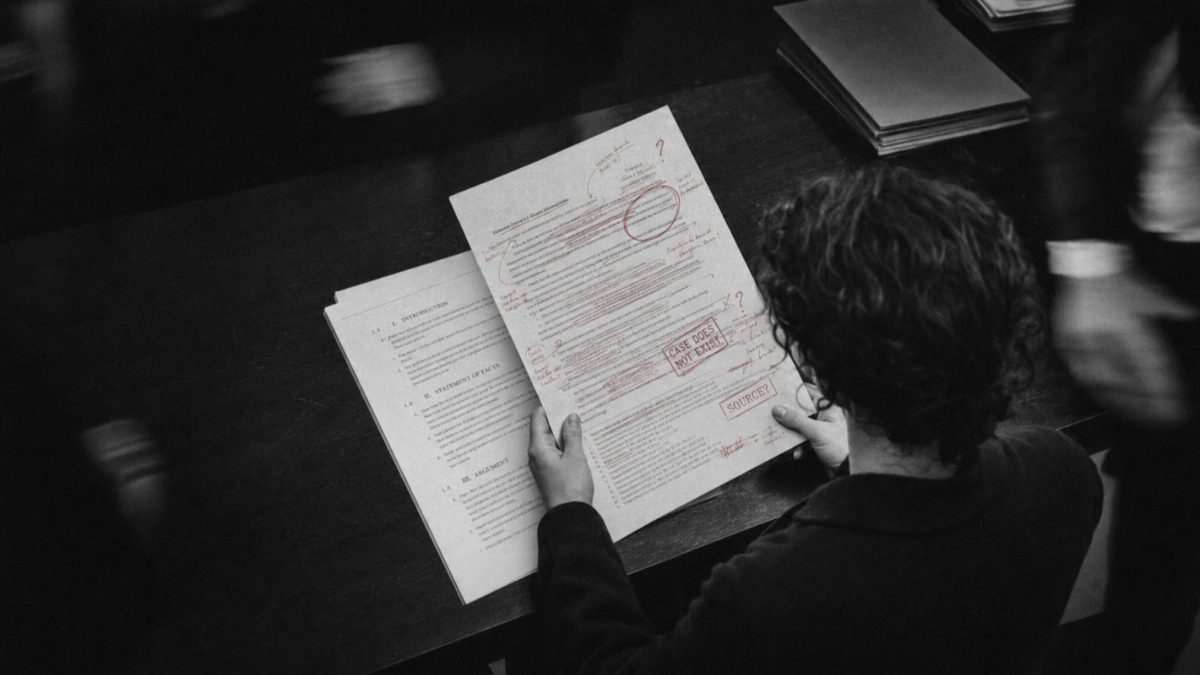
Turns out, some of those cases aren’t real. Neither is that second one. The judge spots this, calls her out, questions her credibility, maybe even threatens to hit her with costs.
Lawyers see an “AI hallucination.” I see a woman locked out of legal help, then blamed for using the one tool she could access.
And the system? It ticked every box. The court provided info. The profession held its standards. The judge kept the process honest. The fake cases were exposed. She is still standing there, alone.
So, what exactly did we protect?
The justice system didn’t fail her with one big, dramatic moment. It let her down in a hundred smaller ways: the price, the complexity, the distance, the warnings she barely understood, the moments she was left out, and then the sting of punishment when she couldn’t do what was asked of her because she’d been shut out from the start.
The Real AI Question
There are really two kinds of AI in the justice system, and we keep talking about them as if they’re the same thing. They’re not.
One kind tries to do the deciding. It nudges the outcome, shapes the reasoning, or stands in for judgment itself. That’s the dangerous one. That’s where the judge’s oath matters, because you can’t outsource responsibility and still pretend the decision stayed human.
The other kind doesn’t decide anything. It just helps catch what people miss. Did that case actually exist? Is a document missing? Did this self-represented person turn a messy story into something the court can actually follow? Did someone flag that this argument looks wildly off compared with similar outcomes? That isn’t robot judging. It’s error detection.
So no, these aren’t just two versions of the same problem. One is about who gets to decide. The other is about whether the system gives people a fighting chance to be heard.
If AI is doing the first, that’s a problem. If it’s doing the second, and doing it properly, maybe that’s part of the solution.
What the Courts Actually Say
Australian courts are already paying attention. The Victorian Law Reform Commission’s 2026 report calls for a principles-based framework, clear guidance, better education, and real oversight of how AI is used.
The real question is whether AI helps someone be heard, or whether it quietly starts deciding their fate for them.
Still, the simple question, should a robot replace the judge? It gets a hard no.
The tougher question is what happens to everyone who can’t afford to make themselves understood to a judge in the first place.
Access Is the Gap
Legal debates about AI often assume everyone is choosing between a lawyer and a chatbot. For lots of people, though, the real choice is AI or nothing.
Less than 8% of Australians are eligible for legal aid. Right now, in Australia, there are ninety-six court decisions that relied on fake, AI-invented precedents, and seventy-two of those came from regular people representing themselves. They walked into court, trusted the only tool they could afford, and cited cases that never even existed.
That’s not about careless users. That’s about people locked out of the profession, just trying to get by with whatever help they can find.
AI can make the law answer you without making it truly accessible. Getting an answer isn’t the same as understanding what it means, being able to check the source, or spot a mistake.
You ask a chatbot what the law says. But if you can’t see where it got that information, can’t read the actual case, can’t know when it’s making something up, you haven’t really gained any power. You’ve swapped one for another, except the new one is affordable.
And people relying on it? Often, they’re the least equipped to spot when it’s wrong. Someone with money might send AI’s output to a lawyer for review. A self-represented litigant just sends it straight to court.
One person gets efficiency, the other just gets exposed.
And affordability isn’t some side note. If only people who can pay lawyers to double-check an AI’s advice can actually use the tech safely, then nothing’s changed. The justice gap is still wide open. We just end up with a system where the well-off get AI plus review while everyone else gets AI plus risk.
So AI quietly widens the gap, without ever charging a dime.
Warnings Don’t Fix It
And we still act like it’s recklessness. Australian courts have already seen self-represented litigants caught out by AI-generated, fake citations. It’s easy to see these as stories of carelessness: They got warnings. They should have checked. They shouldn’t have relied on a chatbot.
Maybe, on paper, that’s true. But checked against what: a paid legal database they can’t access? Training they never received? A lawyer they couldn’t afford?
We keep repeating that ignorance is no excuse. Then we bury the law behind technical language, scattered rules, paywalled databases, and legal services most can’t use.
We warn people that AI isn’t safe, then offer no safe alternative.
We tell them to get legal advice, they already tried.
The system asks why she trusted a chatbot. She asks why the court gave her nowhere else to turn.
We count their mistakes but never ask what made those mistakes inevitable.
The Court Is Starting to See It
Federal Courts are waking up to the reality that self-represented people will keep using AI, like it or not. The conversation is turning: how can we use tech so people can actually communicate the substance of their case, not just get tripped up on rules?
A tool provided by the court wouldn’t need to give legal predictions or advice. It could just help people structure their stories into something readable. Simple, structured questions: What happened? What outcome do you want? Which documents matter? What dates? What legal issue does this raise?
The tool puts this in the correct format but keeps the person’s words. And it checks every case it cites before you can print or upload it.
So the hallucination problem isn’t just warned away, it’s designed out.
This isn’t automating lawyers. It’s refusing to make legal fluency the ticket to entry.
What a Safer System Looks Like
If we learned anything from aviation, we’d stop trying to build a robot judge and start building guardrails around the human system:
- A court-run, free tool for unrepresented users. Connected only to verified law, rules, and cases. Walks people through the process, checks for missing info, and verifies sources before anything gets filed.
- An independent flag for consistency. Automatically alerts if an outcome seems really out of step with similar cases. Doesn’t decide the case, just says, “Are you sure? Look again.”
- Mandatory protocols for any legal AI. Set out what it does, what it must never do, who audits it, what sources count, and how errors get handled.
- Public governance. Not just for judges and lawyers. Bring in technologists, evidence experts, and people who’ve tried to represent themselves.
None of this is radical. It’s just the basic expectation for any system where human error is inevitable.
Aviation’s Lesson
This is the analogy I can’t shake: aviation.
For decades, after every crash, they looked for the “bad” human. The wrong call, the missed warning, the poor communication. But blaming individuals didn’t fix the next mistake.
Aviation only got genuinely safer when they admitted that humans will fail, and started building error-detection systems to catch mistakes before disaster. TCAS, the system that prevents midair collisions, doesn’t fly the plane. But it warns the humans before they see danger. That’s true safety: another layer, not a replacement.
In law, we’re barely at the starting line.
Who Actually Owns the Handoff?
We keep talking about putting “a human in the loop.” But what does that really mean?
Which human? When? What are they supposed to check? What can the AI suggest, and when does the human say no? What happens if the two disagree?
Unless those questions are clear, “human oversight” is just a comforting slogan.
A tired registrar clicking “approve” counts as a human in the loop. A judge handed a risk score, with no context, is technically in the loop. A litigant told to check their own chatbot output? Also apparently enough.
None of those scenarios guarantee anyone spots the mistake, has time to fix it, or knows what they’re accountable for.
The real risk isn’t just a bad decision by AI. It’s a fuzzy handoff, where everyone assumes someone else checked.
What’s Really at Stake
Judges can keep their oaths. Human decision-makers still run the show. Nobody is calling for a robot to decide on people’s freedom, their kids, or their homes.
But legal professionals can’t afford to keep saying “a human made the call” and act like that proves fairness. The question isn’t “did AI get involved?” but, “how was it used, who was responsible, and did it actually help someone get heard?”
So, go back. She got a court notice. She called for help. She couldn’t pay. She used what was there. The tool faked a case. The judge caught it. The court protected its own logic. Every step of the system operated as planned. She was still alone.
We can keep lecturing people not to trust unsafe AI. Or we can build them something safe, because they’re already telling us what they need.
A court tool. Verified sources. A system that flags weird results. Clear handoffs. Public review. No robot judge. And no pretend-neutral “system” either.
Human decisions, with safety watching overhead. Because you can’t claim access to justice if you tell people to hire lawyers they can’t afford, ban them from the technology they do have, and then punish them for the very gap we’ve baked into the process.
She didn’t pick AI over a lawyer. She picked AI over silence.
The least we can do is make sure it lets her speak the truth.