
Imagine this: a guy racks up three costs orders over parking disputes. All up, they total $3,987.58. Five years down the line, he decides he wants more time to challenge them. So what does he do?
He turns to AI with a question most people would find reasonable: Can a court really make me pay almost four grand in legal costs for parking?
It feels, well, a bit... much.
The AI spits out an answer that sounds logical. It talks about proportionality, even gives a made-up case, citation, and a measured legal explanation that costs should relate to what’s at stake.
Parking. $4,000.
Surely someone, somewhere, has to look at whether that is fair.
He marches off to the Supreme Court of Tasmania, citation in hand. Turns out, the court can’t find any trace of it. They check the citation, wonder if it’s a typo, look again. Nothing.
That’s because the case doesn’t exist. It was generated by AI.
And the court is right to toss it out. You can’t ask a judge to rule based on some case a chatbot dreamed up because it sounded about right, using law that does not exist.
Usually, this is where the conversation stops. The AI invented a case. The man should not have relied on it. The Court rejected it. Lesson learned: do not trust AI with legal research.
Fine.
But I am much more interested in what the AI invented.
Think about it. The AI could’ve gone in any direction. It could have dreamed up a secret exception for parking tickets. Or thrown out a Latin phrase nobody’s ever heard. Maybe some weird loophole buried in an old statute. Even a hyper-technical rule so bizarre that no regular person would ever think to bring it up.
But it didn’t do any of that. It handed him proportionality. It gave him the justice system we always say exists.
See, these invented cases aren’t usually about weird loopholes or outlandish arguments. They sound just like the law the average person expects to find if they take courts at their word.
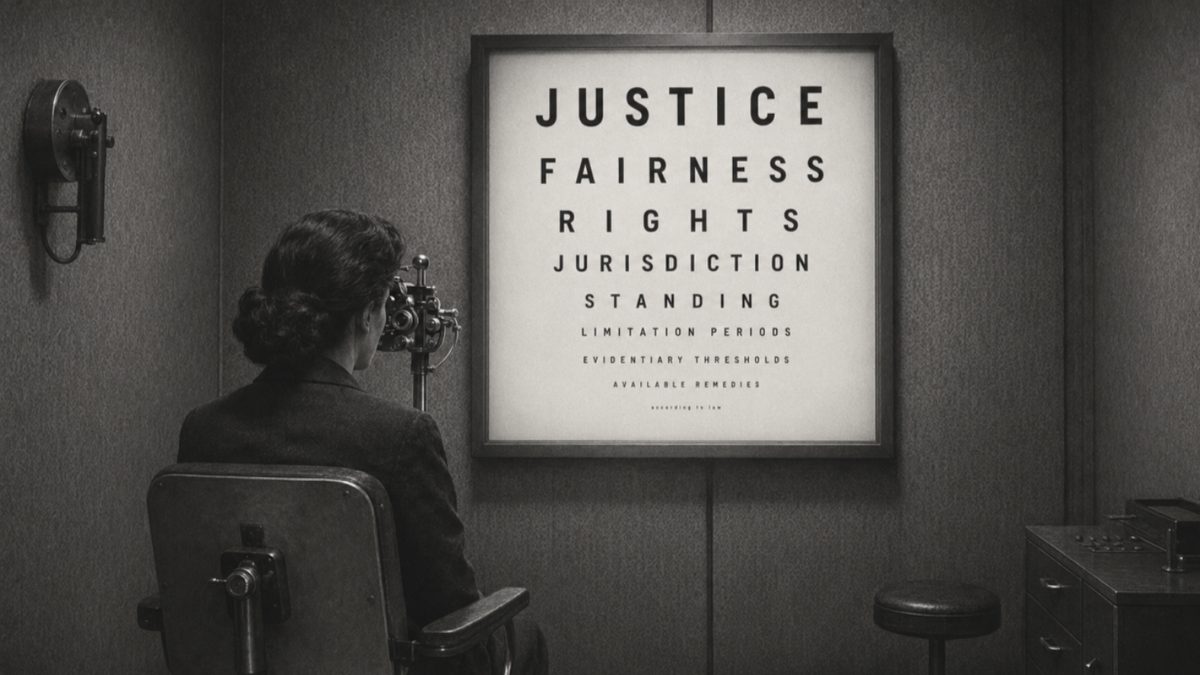
Listen to how the justice system talks.
The law speaks in two languages
If you read judgments, legislation, or just skim a court website, you’ll see it: fairness, equality, rights, words that turn up everywhere. They’re in speeches, law school lectures, brochures at community legal centres. But when someone actually needs one of those words to do something? The language shifts. Suddenly, it’s jurisdiction, standing, limitation period, evidence, discretion, correct form, available remedy... and in this case, a five-year delay.
The public hears, “Justice should be fair.” The law replies, “Let’s talk technicalities.”
It’s no wonder people get lost.
Lawyers reading this will say, “Well, that’s not how the law works.” And technically, they’re right.
Courts aren’t there to fix every result that stings. Not every principle creates a path to a remedy. Rights exist, but they don’t always get you what you hoped for. Appeals aren’t do-overs just because you didn’t like the first go-around. Human rights bodies aren’t obliged to investigate every injustice anyone can name. But that’s the core of the problem.
The inventions have a pattern
Jovanovic v Hobart City Council is one case, but the proportionality argument belongs to a much larger pattern.
But proportionality comes up a lot. Looking over Australian cases where people tried to use AI-generated legal material in court, I’ve seen a pattern: the fake cases always pop up at the gap between “justice promised” and “result delivered.” Sometimes the AI invents a new ground of appeal that reopens a case someone thinks was just wrong. Or it conjures a duty that requires agencies or regulators to investigate properly, just what someone wanted. Sometimes it transforms a general principle like fairness, equality, or “the best interests of the child” into a hard rule, as if the court has to fix things if you just say the magic words.
There are other fakes: invented sections of law, quotations that never happened, real cases twisted into saying things they never did. Each time, the AI builds a bridge: “The system says it cares about fairness, so there must be a rule to fix this situation.”
Why fake law sounds real
AI pulls plausible words together. But it can’t actually think like a lawyer, check sources, or explain context.
But there’s a reason these hallucinations are so believable.
Why did that fake case seem so real?
Well, AI doesn’t actually go digging through a database for a real case when you ask, it just fills in what a case ought to look like. Legal citations are a prime example. The structure, the names, the year, the court, the number, shows up everywhere in legal writing, but the actual details for any single judgment pop up only rarely. So the AI figures out the general pattern much better than it memorises real cases.
It understands: okay, here goes two convincing party names, next is a year, then a court abbreviation, and finally some numbers. And right after that, lawyers expect a polished little summary of what the court supposedly decided.
Say you prompt it for a case about proportionality. The AI cobbles together a very convincing citation, tosses in a relevant-sounding ruling about proportionality, and hands that back.
Everything looks right, every word in the right spot, even though the case doesn’t exist.
What people are actually asking
Here’s what people really want when they show up asking AI for legal help: they don’t care about a detailed breakdown of statutes or court rules. They just want to know, is anyone actually going to listen? Is there something out there that protects me? Can I finally explain my whole situation, not just what fits into a bunch of little boxes on a form? Does fairness count for anything?
Those questions are real, and honestly, they make sense. The problem is just connecting that gut feeling, something’s wrong, with how the law actually works. Most people have no idea if their sense of injustice matters in court, what facts matter, or what help the law could offer.
And let’s be real: a lot of people fall through the cracks. They don’t qualify for legal aid, but hiring a lawyer is just way out of reach. Maybe they’ve got a degree, maybe they’re good at explaining themselves, but none of that means they magically know the tangled difference between right and wrong, the law, a proper claim, or what a judge wants to hear.
Take Australia, for example. UNSW researchers found that out of 84 court matters involving AI, 66 had people representing themselves. That doesn’t mean people without lawyers are careless, it just shows who’s most likely to ask an always-ready, free, and confident AI for help.
AI’s there when everyone else isn’t. It doesn’t shut you out because you don’t fit some eligibility form. It doesn’t tell you, “Sorry, all full, come back in three weeks.” It doesn’t force you to choose between paying the rent or paying for answers. And it never asks if your problem is important enough. Legal aid? That’s only available to less than 8% of Australians, and not even all of them under the poverty line can get it.
Responsibility is not the same as ability
People are still responsible for what they file in court, even if an AI gave them the words. Courts need real cases and arguments. The other side shouldn’t have to spend time and money fighting stuff that’s made up. Judges shouldn’t have to become detectives. But just saying “Use AI responsibly” doesn’t cut it. Telling a self-represented person to “verify” a case assumes they know where to look and how to check. That’s specialised legal research, not a typical life skill.
Responsibility also depends on experience and resources. A trained lawyer with subscriptions and duties is in a different spot from someone using a free chatbot because that’s all that’s left. Both file documents. Their mistakes are not the same. Our solutions shouldn’t pretend otherwise. None of this excuses fake filings. But it changes what help looks like.
Courts are putting out guidance, practice notes, and warnings. They should. Victoria’s latest note even says AI tools might improve access to justice, if you use them carefully. But warnings just tell people what not to do. They don’t help someone actually do what they need. If a person used AI to figure out whether they could appeal, and you tell them “don’t rely on unverified AI,” that doesn’t answer their real question. They still need to know: can they actually appeal, are they in time, what counts as a legal mistake, what evidence they need, what court to take it to, what the court can change.
Don’t cross the dangerous bridge. Okay, so how do you cross safely? Verification guidance has to make sense to someone who’s not already a lawyer. Where can you search for a case without a subscription? How do you check if laws are current? What if AI steered you wrong, but your problem is still real? Who translates a messy lived experience into something the court can see? People need to try to understand the legal system. But the system owes them some clarity, too.
The case that never was
The Supreme Court did the right thing tossing the fake authority in Jovanovic’s case. He waited five years. The court didn’t see enough reason to give him an extension. The imaginary case didn’t create his problem, and ignoring it wasn’t the only reason he lost. Still, that fake case answered the real question he was asking: is there some part of the law that can see what happened to me, and judge if it’s actually fair?
The legal answer is often “no.” But the expectation underneath, the hope, is real. Somewhere, between “justice should be fair” and “your application’s five years late,” there’s a gap. Instead of a real explanation, AI filled it with a judgment from a court that never existed, a pathway that was never there. We should ask ourselves why AI made up that answer.
And the justice system should ask itself why the fake seemed easier to find than the truth.
Next issues will be about…
This piece is the starting point. The next issues will move from the big question why does fake law sound so real? to the actual Australian cases.
Over at Lejacie, our future-of-practice lab and legal and policy implementation studio, we are taking a closer look at what AI hallucinations in court documents are really doing.
#2 The Law People Were Looking For
The first piece will examine Australian cases involving self-represented litigants who relied on AI-generated legal material.
Not simply to catalogue fake cases, invented legislation or fictional quotations. The deeper question is what the false authority was trying to achieve.
What did the person hope the invented case would establish? A right of appeal? More time? A duty to investigate? A finding that an outcome was disproportionate or unfair? A remedy that would make someone listen?
The inquiry is not whether courts should accept fake law. They should not. It is whether these cases reveal something important about the justice people expect to find and the gap between that expectation and the legal pathways actually available.
#3 The Law Lawyers Stopped Checking
The second piece will look at lawyers who rely on hallucinated law.
A lawyer and a self-represented person may use the same tool, cite the same fictional case and receive the same warning from a court. But they are not telling the same story.
When a self-represented person relies on fake authority, the question may be: what were they trying to get the justice system to recognise?
When a lawyer relies on fake authority, the question is different: what part of their job did they think could safely be handed over without verification?
Legal research. Citation checking. Drafting. Analysis. The professional judgment required to distinguish a real authority from a plausible-sounding one. The duty owed to the court.
One inquiry is about people looking for a way into justice.
The other is about what legal practice loses when the people entrusted to translate law stop checking whether it is real. Lejacie, a lab focused on the future of legal practice and policy, will be releasing these reports.
Sources
Jovanovic v Hobart City Council [2026] TASSC 39 (Supreme Court of Tasmania). Coverage: Pulse Tasmania and The Mercury.
AI use by self-represented litigants (84 court matters, 66 involving self-represented people, September 2025): UNSW Newsroom. See also the November 2025 report “GenAI, Fake Law and Fallout”.
Court guidance on AI: Supreme Court of Victoria Practice Note SC Gen 25, “The use of Artificial Intelligence by Court Users.” Supreme Court of Victoria.
Legal aid eligibility (around 8%): National Legal Aid and the Law and Justice Foundation of NSW.