
A Lejacie professional archetype
The Adviser
Makes complex rules, risks and obligations usable, defensible and safe for decisions.
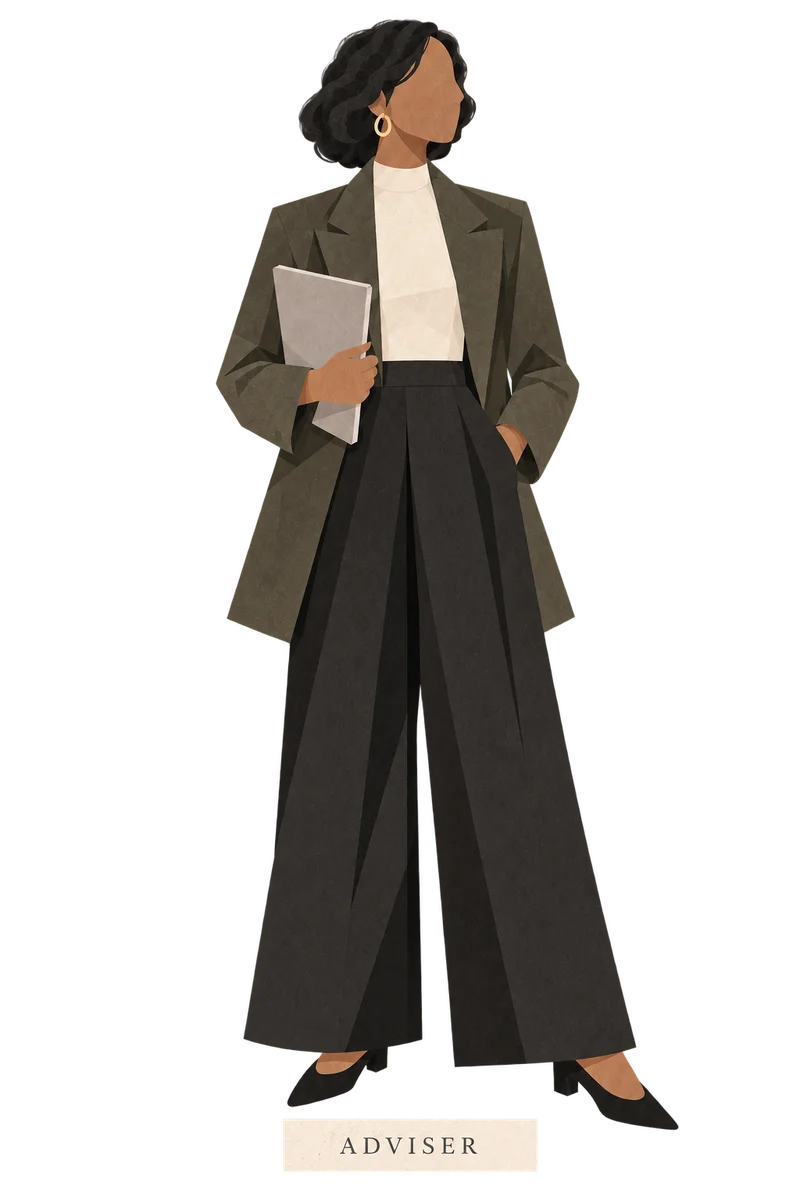
You may be an Adviser if you keep asking:
“What does the framework actually require, and what is the safest, most defensible way to act?”
You may notice ambiguity, exceptions, exposure and the consequences of an incorrect interpretation.
What you may notice first
Ambiguity in rules, exceptions, obligations, exposure, technical risk and the consequence of an incorrect interpretation.
What you may do unusually well
- Technical precision and doctrinal reasoning
- Risk recognition and careful qualification
- Structured comparison of options
- Reliable written advice and decision support
- Ability to hold complex rule systems without losing detail
Productive difficulty
The kind of hard work that may suit you.
Complex but bounded questions where accuracy matters and a strong interpretation changes the decision.
What makes the effort worthwhile
Correctness, defensibility, reliability, mastery and being trusted with consequential judgement.
Costly friction
Work you may be able to do, but may not want to centre.
You may become depleted by:
- Persistent political ambiguity
- Pressure to simplify beyond what is defensible
- Constant live persuasion or social performance
- Open-ended redesign without clear authority
- High-volume reactive work that prevents careful judgement
This does not mean you cannot do those things.
It means a role built mostly around them may underuse your strongest contribution.
Career families to explore
An Adviser pattern may show up across: Transactional and advisory law; compliance, risk and governance; technical in-house counsel; public law; regulatory affairs; specialist assurance.
Broad pathway zones:
- Commercial and specialist advisory
- Tax, competition, privacy, data and financial-services regulation
- Contracts and transactional risk
- Government legal and administrative decision-making
- Compliance, governance and specialist assurance
- Technical in-house counsel
The families it connects to most often: Transactional/advisory; compliance/risk; technical public law; specialist commercial advisory.
The setting matters. Often thrives where technical authority is respected, standards are clear, evidence is accessible and advice genuinely affects decisions. Context can range from firms and in-house teams to regulators and government legal units.
Role shape and progression
Likely role shapes. Specialist, senior counsel, principal adviser, technical lead, decision reviewer or expert mentor. People management is optional, not inherent.
What seniority can add or remove. The strongest route often preserves hands-on judgement. General management can reduce fit if staffing and operations replace technical work.
The high-capability, high-cost trap
Becoming valued only for checking, process control and risk containment while deep technical judgement is underused.
More than one pattern can be true
Common blends
- With The Investigator: more evidence-led, review and enforcement oriented.
- With The Translator: excels at making technical advice usable for non-specialists.
- With The Strategist: moves from applying frameworks toward redesigning them.
The Adviser asks what the framework requires and how to act safely within it. The Strategist asks whether the framework itself is producing the right outcomes.
How to test the pattern
Try one low-risk experiment:
Take a public rule, guidance document or policy. Identify the actual decision it governs, the uncertainties it leaves open and the questions a responsible adviser would need to clarify.
Notice how the work feels: your focus, learning speed, energy, frustration and desire to keep going.
The goal is not to prove that you are “an Adviser.”
It is to gather evidence about whether this type of work brings out your best.
A pattern is not a verdict
The Lejacie Professional Archetypes are reflective work patterns, not diagnoses, fixed identities or career instructions.
The full quiz is designed to consider secondary influences, practical conditions, current career stage, exposure, confidence and pathway evidence.