The Lejacie Professional Archetypes
Eleven ways people create value in complex work.
Not personality types. Recurring work patterns.
Some people see the rule gap first.
Some see the system failure.
Some see the missing evidence.
Some see the person who has been left out.
Some see the decision-maker, the power map, the pathway, the opportunity, the workflow, the unanswered question or the explanation nobody has made clear enough.
The Lejacie Professional Archetypes describe these recurring patterns of professional contribution.
They are not jobs. They are not fixed identities. They are not a test of intelligence, ambition or worth.
They are a vocabulary for understanding how different people may notice, solve and carry difficult work.

Meet the archetypes
Eleven recurring ways people create value in complex work.
 01
01The Adviser
Makes complex rules, risks and obligations usable, defensible and safe for decisions.
You may notice ambiguity, exceptions, exposure and the consequences of an incorrect interpretation.
Meet The Adviser → 02
02The Strategist
Finds the hidden mechanism behind recurring failure and designs what needs to change.
You may notice patterns, feedback loops, incentives, contradictions and the gap between intention and reality.
Meet The Strategist → 03
03The Advocate
Builds and advances a position under opposition, scrutiny or conflict.
You may notice leverage, weak points, decisive issues, audience reaction and what must be proved.
Meet The Advocate → 04
04The Investigator
Reconstructs what happened and reaches findings that can be defended.
You may notice missing facts, inconsistencies, chronology, credibility and procedural fairness.
Meet The Investigator → 05
05The Navigator
Moves complex decisions through timing, relationships, influence and power.
You may notice authority, stakeholder interests, timing, narrative, coalition dynamics and strategic openings.
Meet The Navigator → 06
06The Facilitator
Helps people understand, participate, resolve and move forward together.
You may notice misunderstanding, relationship tension, exclusion, emotional cues and what will help people re-engage.
Meet The Facilitator → 07
07The Builder
Turns intention into systems, services, processes and delivery that work in real life.
You may notice bottlenecks, unclear ownership, dependencies, missing processes and implementation risk.
Meet The Builder →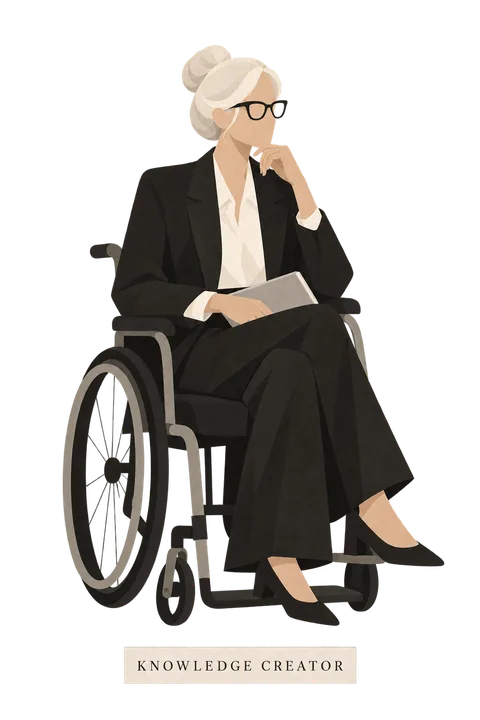 08
08The Knowledge Creator
Produces rigorous understanding that did not previously exist.
You may notice unanswered questions, conceptual gaps, weak evidence, nuance and the deeper structure of an issue.
Meet The Knowledge Creator → 09
09The Translator
Makes complex knowledge understandable, compelling and usable for a real audience.
You may notice jargon, knowledge barriers, audience confusion, the core idea and what will help people act.
Meet The Translator → 10
10The Guardian
Protects people where the consequences of systems are immediate.
You may notice immediate harm, safety needs, rights, urgency, who is unsupported and what a person needs now.
Meet The Guardian → 11
11The Reformer
Moves law, policy or institutions toward a principle, right or social good.
You may notice rights gaps, power barriers, exclusion, values conflicts and opportunities for durable change.
Meet The Reformer →
More than one pattern can be true
You may be a blend.
Most people are not one neat category.
You may have a primary pattern and a meaningful secondary influence.
For example:
- A Strategist–Builder may diagnose the system and carry redesign into implementation.
- A Translator–Reformer may turn complex evidence into public understanding that supports change.
- A Guardian–Advocate may protect people through direct representation, negotiation or formal challenge.
- An Adviser–Investigator may combine technical judgement with evidence-led findings.
- A Knowledge Creator–Translator may develop rigorous insight and make it travel beyond specialist audiences.
The quiz is designed to identify whether a secondary influence genuinely changes the career guidance, not to give everyone a decorative list of labels.
The archetypes are only the first layer
The same archetype can thrive in very different careers.
A Builder may work in legal operations, disability service design, public-sector implementation, program delivery, digital transformation or community-service reform.
A Translator may work in legal education, public information, policy communication, journalism, professional learning, advocacy or research translation.
A Reformer may work in law reform, government, a nonprofit, strategic litigation, a campaign, a research centre or an independent practice.
That is why the quiz does not stop at the archetype.
It eventually connects the pattern to pathways, sectors, organisation types, role shape, conditions and next moves.