
A Lejacie professional archetype
The Advocate
Builds and advances a position under opposition, scrutiny or conflict.
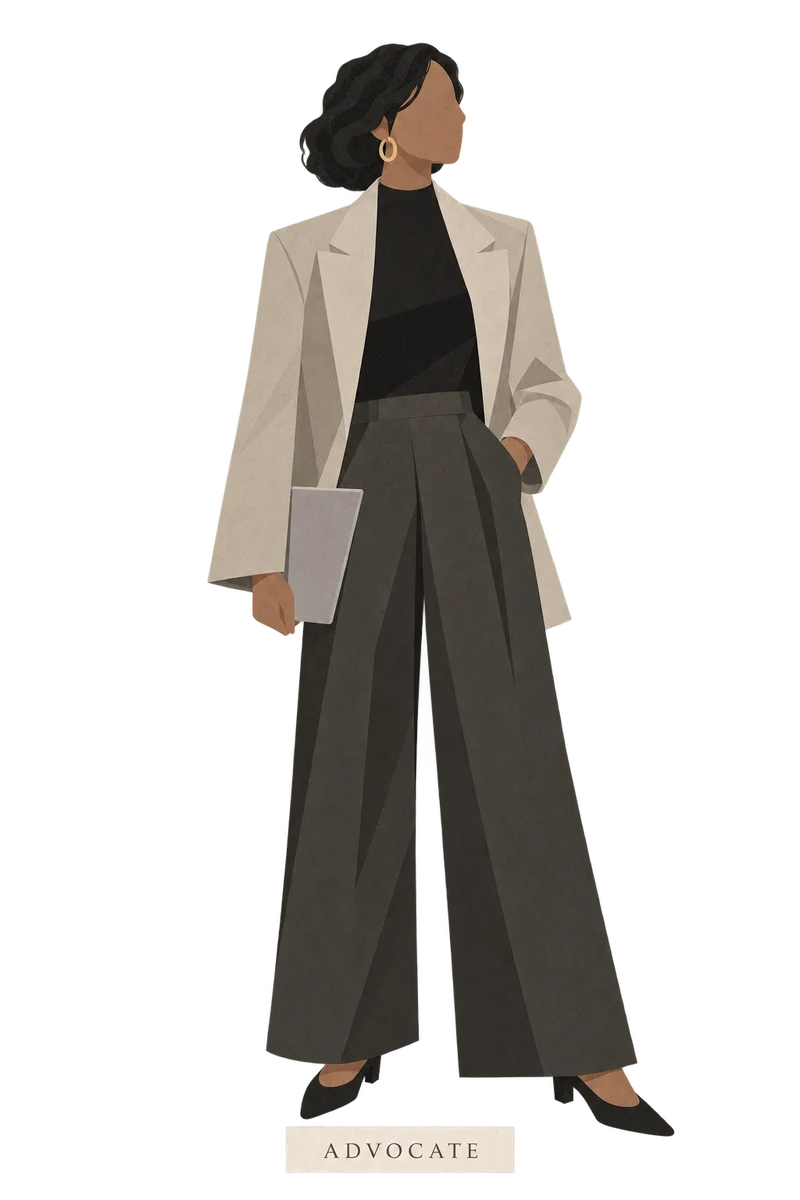
You may be an Advocate if you keep asking:
“What is the decisive issue, what can be proved and how do we move this outcome?”
You may notice leverage, weak points, decisive issues, audience reaction and what must be proved.
What you may notice first
Weak points, contradictions, leverage, audience reaction, what must be proved, what can be conceded and where the real contest sits.
What you may do unusually well
- Adversarial reasoning
- Rapid issue identification
- Persuasive structure
- Strategic response under challenge
- Tolerance for scrutiny and visible decision points
Productive difficulty
The kind of hard work that may suit you.
High-stakes contested problems where there is an opponent, audience, decision-maker or real negotiation.
What makes the effort worthwhile
Winning, protecting a position, securing a just outcome, testing arguments and seeing persuasion change the result.
Costly friction
Work you may be able to do, but may not want to centre.
You may become depleted by:
- Long periods without decision or movement
- Purely neutral analysis with no position to advance
- Chronic conflict without closure
- Administrative case maintenance
- Environments where direct argument is culturally punished
This does not mean you cannot do those things.
It means a role built mostly around them may underuse your strongest contribution.
Career families to explore
An Advocate pattern may show up across: Disputes, advocacy and resolution; litigation; prosecution; criminal defence; arbitration; mediation; employment disputes; strategic litigation; negotiation-heavy work.
Broad pathway zones:
- Civil and commercial litigation
- Criminal advocacy and prosecution
- Employment and industrial disputes
- Arbitration and contentious regulation
- Strategic litigation and public-interest advocacy
- Negotiation-heavy advisory and dispute strategy
The families it connects to most often: Disputes/advocacy; strategic litigation; contested enforcement; negotiation.
The setting matters. Fit depends heavily on the type and duration of contest. Complex strategic matters may suit a different profile from high-volume court lists or emotionally intense family disputes.
Role shape and progression
Likely role shapes. Litigator, advocate, barrister, case strategist, prosecutor, enforcement counsel, negotiator or contentious partner.
What seniority can add or remove. Senior practice can preserve advocacy or replace it with client origination, team management and administration. The system must distinguish those routes.
The high-capability, high-cost trap
Becoming known for confidence and crisis response while carrying chronic conflict, unreasonable demands or high-volume adversarial work without recovery.
More than one pattern can be true
Common blends
- With The Investigator: stronger factual and evidentiary orientation.
- With The Navigator: stronger live audience, stakeholder and framing instincts.
- With The Guardian: contest is organised around direct protection of people.
The Advocate advances a party, position or outcome. The Investigator is accountable for impartial findings.
How to test the pattern
Try one low-risk experiment:
Read two opposing submissions, public inquiry positions or debate pieces. Identify the decisive issue, each side’s strongest argument and what evidence would change the outcome.
Notice how the work feels: your focus, learning speed, energy, frustration and desire to keep going.
The goal is not to prove that you are “an Advocate.”
It is to gather evidence about whether this type of work brings out your best.
A pattern is not a verdict
The Lejacie Professional Archetypes are reflective work patterns, not diagnoses, fixed identities or career instructions.
The full quiz is designed to consider secondary influences, practical conditions, current career stage, exposure, confidence and pathway evidence.