A Lejacie professional archetype
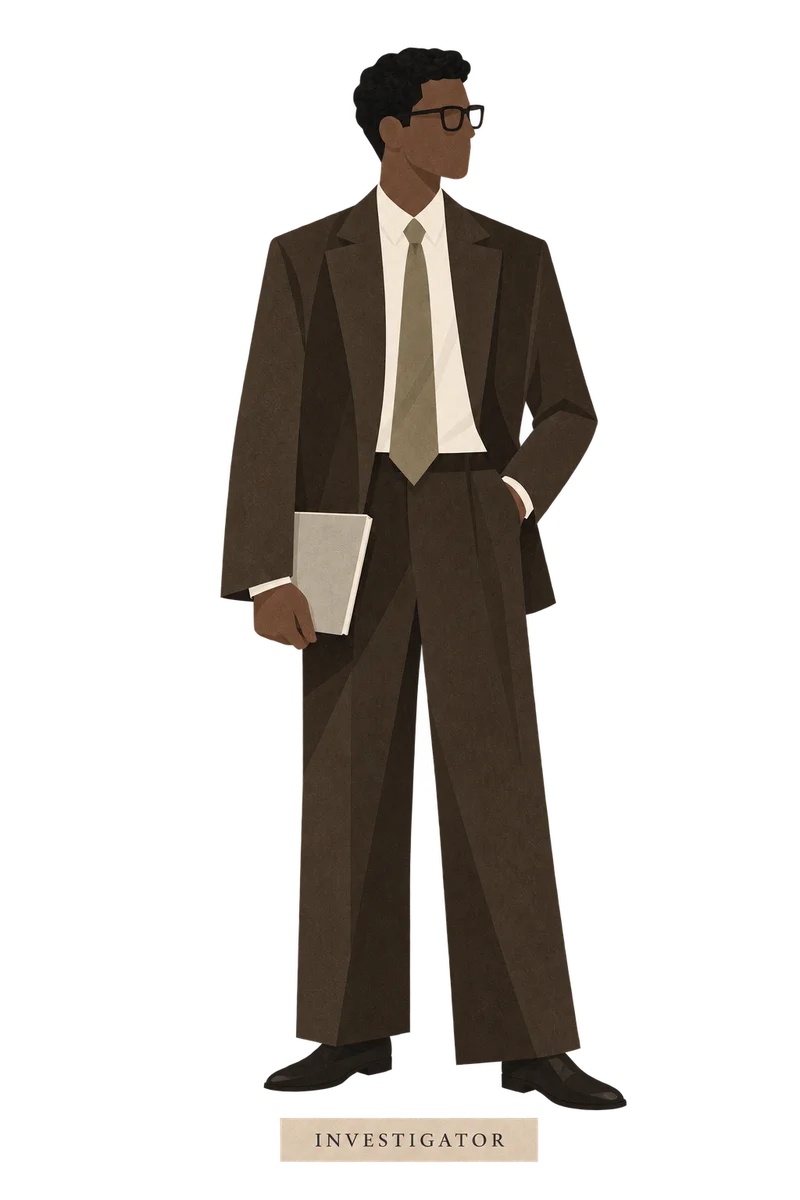
The Investigator
Reconstructs what happened and reaches findings that can be defended.
You may be an Investigator if you keep asking:
“What does the evidence actually support?”
You may notice missing facts, inconsistencies, chronology, credibility and procedural fairness.
What you may notice first
Missing facts, inconsistencies, chronology, credibility, procedural fairness, evidence quality and alternative explanations.
What you may do unusually well
- Evidence reconstruction
- Careful interviewing and fact testing
- Procedural judgement
- Impartiality under pressure
- Clear findings and reasoning
Productive difficulty
The kind of hard work that may suit you.
Incomplete, sensitive or contested evidence requiring careful reconstruction and fair process.
What makes the effort worthwhile
Truth, fairness, accountability, certainty and protecting the legitimacy of the finding process.
Costly friction
Work you may be able to do, but may not want to centre.
You may become depleted by:
- Pressure to prejudge outcomes
- Political interference
- Vague roles with no authority to conclude
- Continuous emotional exposure without recovery
- Pure advocacy where neutrality is impossible
This does not mean you cannot do those things.
It means a role built mostly around them may underuse your strongest contribution.
Career families to explore
An Investigator pattern may show up across: Investigations, integrity and enforcement; regulatory work; workplace investigations; fraud; complaints; misconduct; safeguarding; disciplinary work; inquiries; ombudsman roles.
Broad pathway zones:
- Regulatory and enforcement investigations
- Workplace and misconduct investigations
- Integrity agencies and professional standards
- Complaints, ombudsman and disciplinary work
- Fraud, safeguarding and incident review
- Commissions, inquiries and evidence-led review
The families it connects to most often: Investigations/integrity; oversight; assurance; disciplinary and findings work.
The setting matters. Strongest where independence, procedural fairness, evidence access and decision authority are protected. External consulting, regulators and integrity bodies can differ substantially in pace and neutrality.
Role shape and progression
Likely role shapes. Investigator, inquiry officer, review lead, integrity adviser, findings decision-maker or investigative consultant.
What seniority can add or remove. Senior roles may retain complex findings work or shift into team oversight and institutional risk. Specialist review and decision roles can preserve fit.
The high-capability, high-cost trap
Absorbing excessive emotional detail or carrying responsibility for systemic failure beyond the investigative role.
More than one pattern can be true
Common blends
- With The Adviser: produces highly rule-bound and defensible findings.
- With The Strategist: uses findings to diagnose systemic failure.
- With The Guardian: greater protective and victim-centred orientation.
The Investigator establishes what the evidence supports. The Adviser interprets what the rules require, and the Advocate argues for a position.
How to test the pattern
Try one low-risk experiment:
Take a public inquiry, ombudsman decision or investigation report. Reconstruct the timeline, claims, evidence and alternative explanations before reading the findings.
Notice how the work feels: your focus, learning speed, energy, frustration and desire to keep going.
The goal is not to prove that you are “an Investigator.”
It is to gather evidence about whether this type of work brings out your best.
A pattern is not a verdict
The Lejacie Professional Archetypes are reflective work patterns, not diagnoses, fixed identities or career instructions.
The full quiz is designed to consider secondary influences, practical conditions, current career stage, exposure, confidence and pathway evidence.