
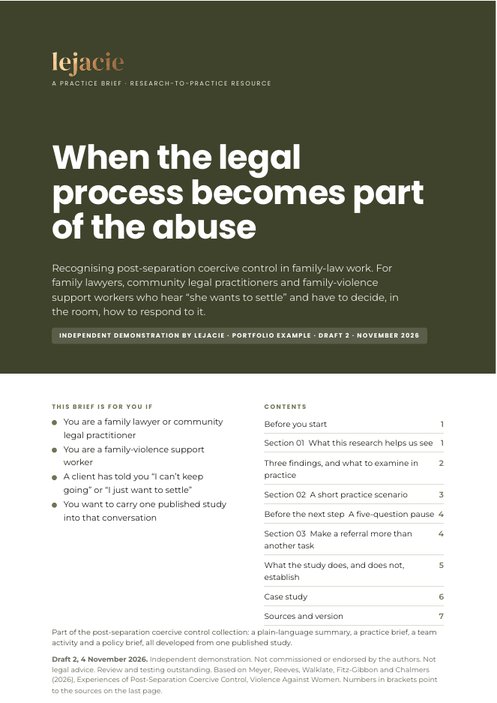
Practice brief · Keeping people safe
When the legal process becomes part of the abuse
Why “she wants to settle” may not be a change of instructions, and what to ask before treating it as one.
Selected research and practical resources for practitioners, educators and leaders across the community services, health and legal sectors. Understand the findings, consider their implications and explore resources for reflection, discussion and learning.
“What does this research mean for my work, and how can I use it with my team?”

Both dates are shown on every card: when the research was published, and when Lejacie last reviewed the resource. A new resource may draw on an older, still-relevant study.
Practice brief · Keeping people safe
Why “she wants to settle” may not be a change of instructions, and what to ask before treating it as one.
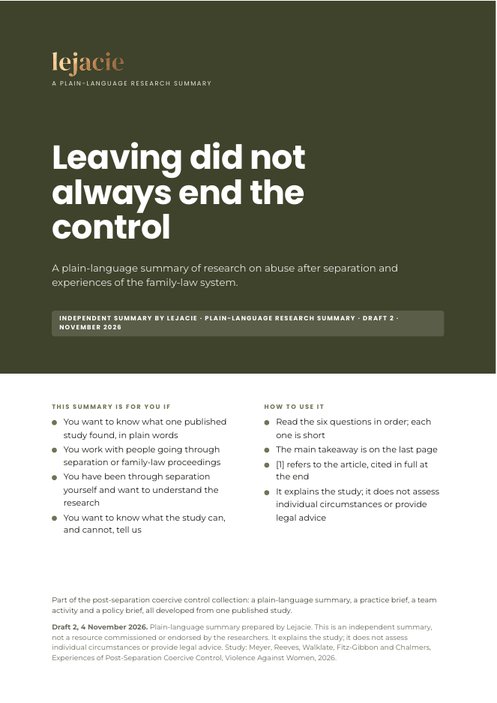
Research summary · Keeping people safe
What the researchers found about abuse after separation, in words a client or community can use.
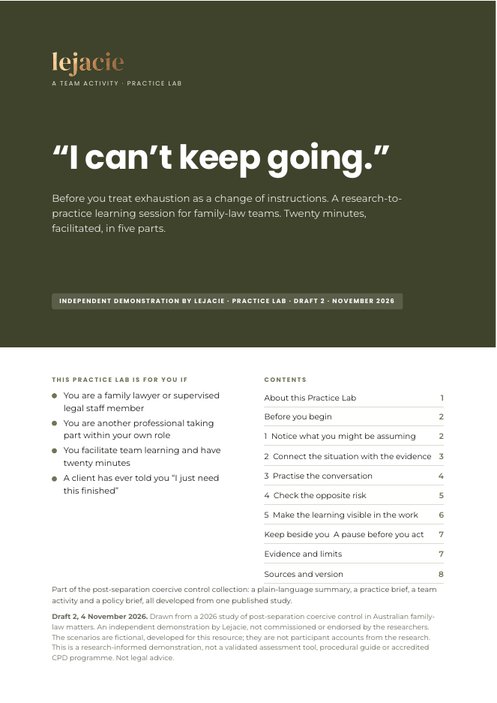
Reflective activity · Keeping people safe
A twenty-minute facilitated session for a family law team to practise clarifying before assuming.
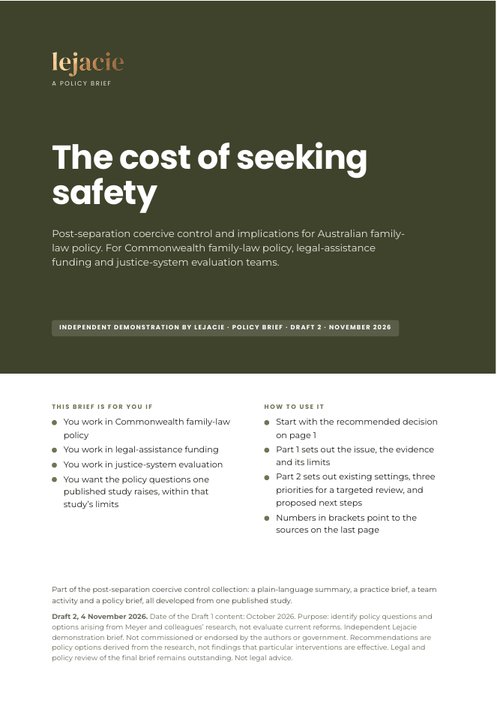
Policy brief · Keeping people safe
What the findings suggest policy and funding teams should examine, and what the study cannot settle.
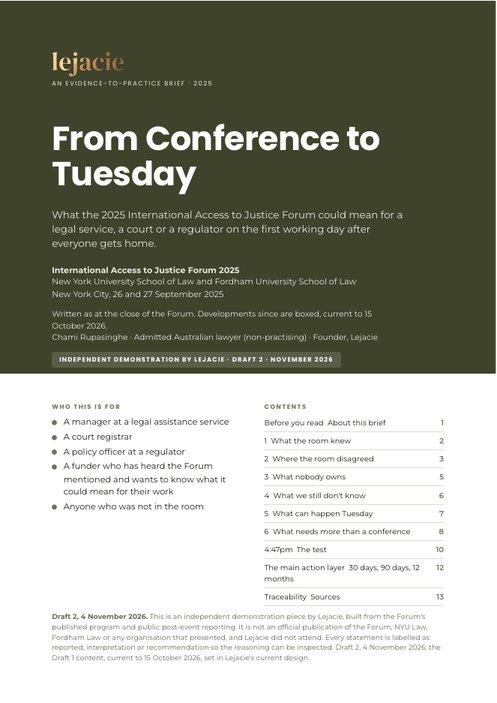
Practice brief · Research into practice
What someone can take back to their work on the first working day after an access-to-justice forum.
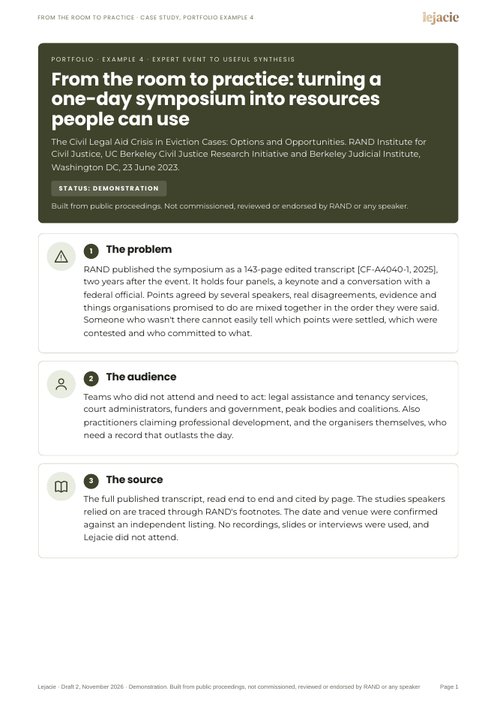
Research summary · Research into practice
A conference synthesis built so the discussion is useful to people who were not in the room.
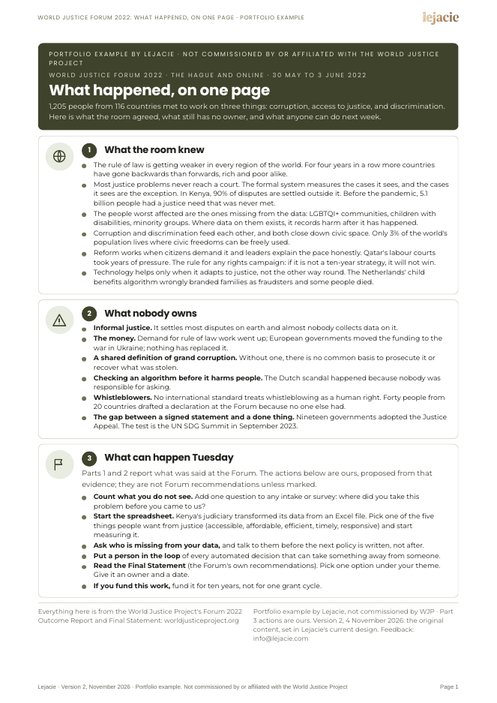
Resources to share · Research into practice
One event translated six ways, showing how the same material changes for each reader.
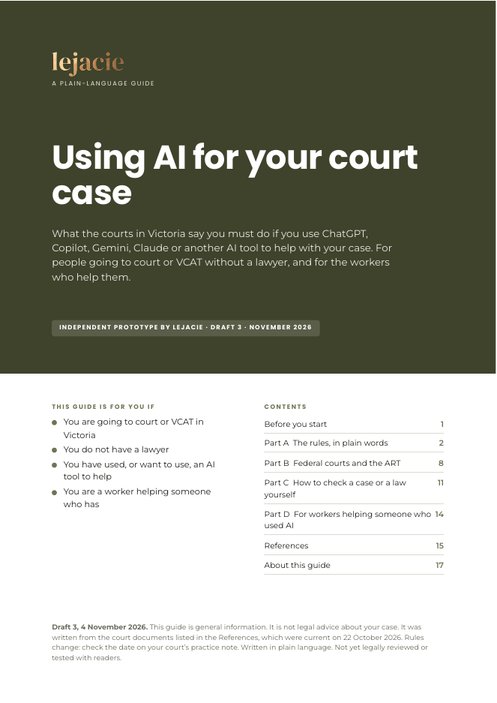
Resources to share · Safe and responsible professional practice
A plain-language guide professionals can hand to someone going to court without a lawyer.
Nothing in the collection matches those filters yet. Lesson plans are the next format we are adding. Suggest research you would like to see here.
The same study, developed for four different uses. Read it, discuss it, teach with it or share it. Not every study needs every format; we develop companion materials when there is a clear audience and use.
Research summary
For communities and the public.
Practice brief
For family lawyers and support workers.
Reflective activity
A Practice Lab for a team discussion.
Policy brief
For policy and funding teams.
Meyer, Reeves, Walklate, Fitz-Gibbon and Chalmers (2026), Experiences of Post-Separation Coercive Control: Family Law-Involved Victim-Survivors’ Perspectives on Coercion, Litigation Abuse and Financial Impacts, Violence Against Women.
The practice question
“She wants to settle.” “She cannot afford another report.” “She says she cannot keep going.” Before treating these as a straightforward change of instructions, what is driving them?
About the research
A qualitative Australian study. The researchers analysed accounts from 14 women who described financial harm connected with coercive control, separation and family law involvement: six written survey responses and eight interviews, selected from a larger Australian study of people who had experienced coercive control. Data were collected in 2021; the article was published in 2026.
Key findings
Three patterns. Pursuing safety could consume the resources needed to rebuild: women described spending savings, borrowing from family or friends and using assets to fund proceedings, with some left in debt or with reduced housing security. The costs went beyond legal bills, to employment, health and the ability to participate. And some women described former partners deliberately using proceedings to continue control, which the article calls litigation abuse.
Limitations and context
Qualitative, with participants selected for relevant experiences, so the findings cannot be treated as representative of all separated parents or all family law proceedings. The accounts are participants’ reported experiences, not independently adjudicated findings about particular former partners, lawyers or courts. The study did not evaluate any practice response.
Implications for practice
The authors’ focus: financial harm and litigation abuse as features of post-separation coercive control, and system responses that failed to recognise or interrupt it. Lejacie’s interpretation: exhaustion may be part of the circumstances shaping a person’s choices, not simply the end result of a difficult case, so the practical question becomes what is happening across the matter and what it is doing to the person’s ability to participate. Questions for further exploration: whether the clarifying prompts in the practice brief change outcomes, and how legal assistance settings account for cumulative cost. The prompts are a translation developed by Lejacie, not interventions the study tested.
Reflect with your team
Resources to use
Learn more
Source: Meyer, Reeves, Walklate, Fitz-Gibbon and Chalmers (2026). Research published: 2026. Lejacie resources reviewed: October 2026. Independent demonstration resources, not commissioned or endorsed by the authors. Not legal advice. Report a correction.
Related events, webinars and recordings live in the events collection, so dates and registration are kept in one place.
We select research that bears on a situation professionals actually face, where a clear audience could use it. Every resource keeps the researchers’ findings, the study’s limitations and Lejacie’s interpretation distinct, names its source and jurisdiction, and shows when we last reviewed it. Resources are independent demonstrations unless a commission is stated, and they are not endorsed by the authors unless we say so. Tell us if something appears unclear or out of date.
Research-to-practice briefs, plain-language summaries, tools, reflective activities and lesson plans, developed for an agreed audience and purpose. Research to Real Life is the fixed-fee package for individual researchers.
Tell us about research, a report or an inquiry finding that would help people in your work. We look for a clear practice question and an audience who could use it.
Or join the list for new summaries, briefs and learning resources, a few emails a year.