

Professional boundaries, ethics and accountability
“Is this mine to handle? When should I seek advice or escalate?”
Knowing the edge of your role, what you can say and do inside it, and how to hand on what sits outside it, without leaving the person stranded.

What this means in practice
Most people who help others with legal, safety or rights questions are not lawyers, and are not meant to be. A teacher, a support worker, a council officer or a nurse still has to decide, in the moment, what they can explain, what they must record, what they can share, and when a question has to go to someone with the authority to answer it.
The hard part is rarely the rule itself. It is the judgement at the edge: being helpful without implying individual advice, staying inside your role without sounding like a brush-off, and keeping a record that protects the person and your practice. We make resources and learning for exactly that edge.
Resources and learning you can open now
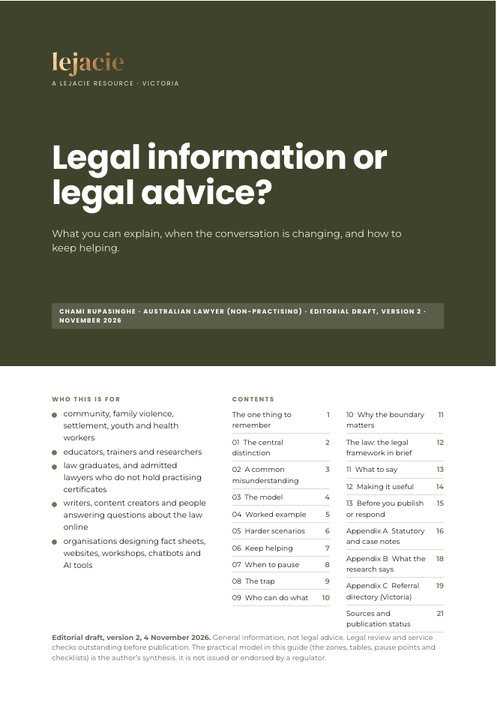 Legal information or legal advice?Guide · For community and family violence workers
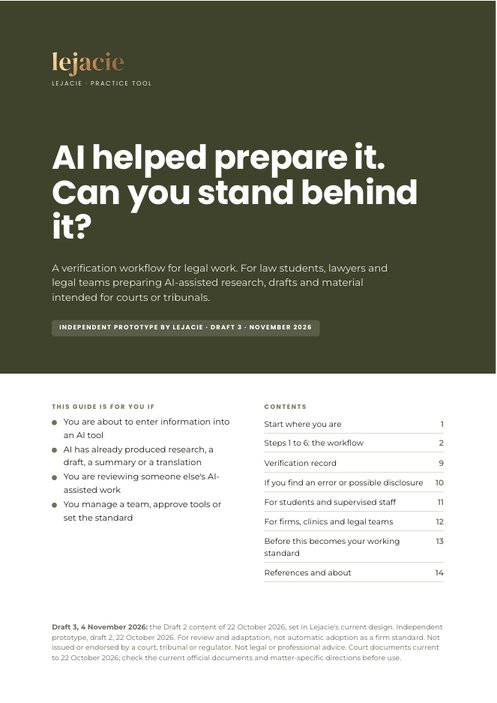 AI helped prepare it. Can you stand behind it?Workflow · For lawyers and legal teams
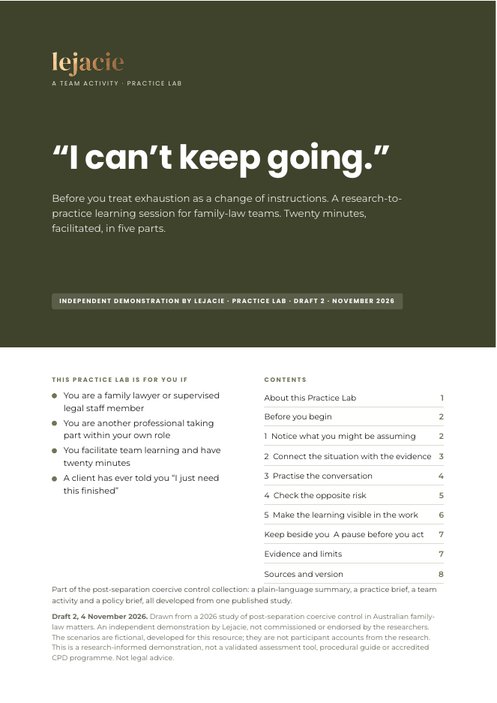 “I can’t keep going.” Practice LabTeam activity · When a client’s distress reaches the edge of your role
- The Usable Handover: nine criteria for sending someone onTool
Relevant learning
Lejacie sessions for this area, shaped to your team:
Events from across the sectors

Workshops, webinars and recordings from other organisations, in the “Reflective and responsible practice” area of our events collection.
What’s changing
All updates, with sources and review dates, are in What’s changing.
Areas we cover
- The line between legal information and legal advice, and what non-lawyers can safely say.
- Scope of role: what sits inside it, what must be referred, and how to refer well.
- Professional codes of conduct and ethics across law, health, social work, teaching and the public sector.
- Confidentiality, conflicts of interest and dual relationships, especially in small communities.
- Record-keeping that protects the person and the practitioner: what to note, when, and in whose words.
- When to seek advice, when to escalate, and who holds the decision.
- Accountability when something goes wrong: disclosure, complaints and learning from it.
- Professional judgement when the rule alone does not give you the answer, including when AI is involved.
What we can develop for this area: Boundary guides for specific roles, escalation and handover protocols, scenario-based team learning, reflective practice sessions and supervision prompts.
Sources and frameworks we draw on
- Legal Profession Uniform Law Application Act 2014 (Vic): what counts as engaging in legal practice, and who may do it
- Victorian Legal Services Board and Commissioner guidance on unqualified legal practice
- AASW Code of Ethics; Ahpra and National Board codes of conduct; Victorian Institute of Teaching Code of Conduct
- Code of Conduct for Victorian Public Sector Employees and the Public Administration Act 2004 (Vic)
- Child Safe Standards and the Reportable Conduct Scheme, Child Wellbeing and Safety Act 2005 (Vic)
- Family Violence Multi-Agency Risk Assessment and Management Framework (MARAM) responsibilities by role
- Australian Open Disclosure Framework (Australian Commission on Safety and Quality in Health Care)
- Privacy and Data Protection Act 2014 (Vic) and Privacy Act 1988 (Cth) on records and disclosure
Different topics. Connected in practice.
 Safety and safeguardingPrivacy, confidentiality and information sharingLegal problems and connected support
 Rights, consent and decision-making
 Accessible communication and community education
 Responsible AI and professional judgement
 Research into practice
 Workplace safety and respectful practice
 Complaints, conflict and putting things right