

Conflict and dispute resolution
“This is escalating. What options should we understand?”
Explore dispute-resolution pathways, preparation and communication, including questions about safety, suitability and power imbalance.

What this means in practice
Most disagreements the people you support are in never reach a court or tribunal, and most should not. They are handled, well or badly, in conversations with a landlord, an employer, a school, a service, a family member or your own organisation.
We develop information and learning on how disputes actually resolve: what the options are, who runs them, when a mediated or restorative approach is appropriate and when it is not, and how to help someone prepare for it in their own words.
Resources and learning you can open now
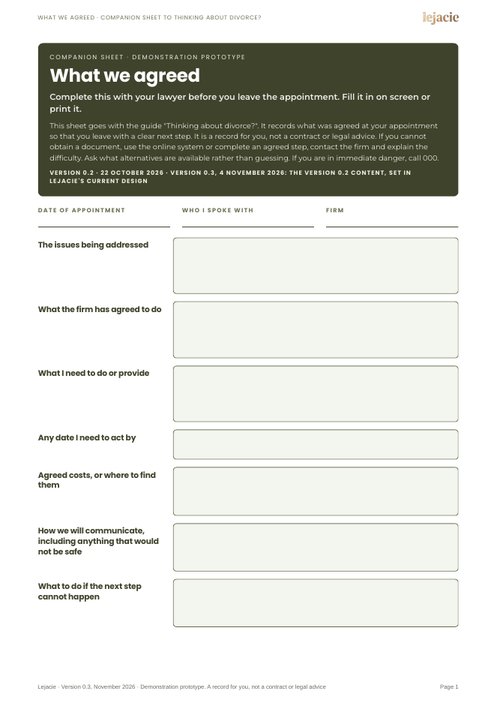 What we agreed: a companion sheet for leaving an appointment with the next steps clearLejacie resource · PDFOpen
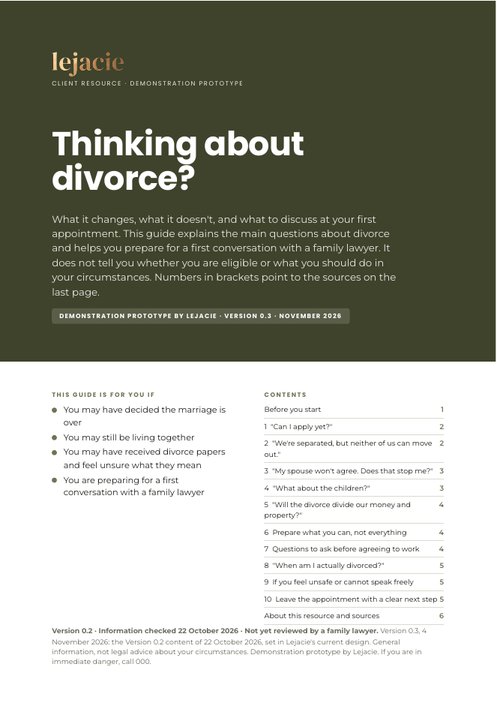 Thinking about divorce? A plain-language client resourceLejacie resource · PDFOpen
- Dispute Settlement Centre of Victoria: free mediation for neighbours, families and communitiesExternal link
- Family Relationships Online and the Family Relationship Advice LineExternal link
- Ask us about dispute-options and preparation resources for your serviceOn this site
Relevant learning
Lejacie sessions for this area, shaped to your team:

Events from across the sectors

Workshops, webinars and recordings from other organisations, in the “Working across services” area of our events collection.
What’s changing
- In effectProperty law changes recognise the economic effects of family violence
The Family Law Amendment Act 2024 (Cth) sets out in the Family Law Act how courts decide property and finances after separation, and makes the effect of family violence, including economic and financial abuse, something the court must consider. Companion animals are also now dealt with expressly.
Who it affects: Anyone separating with property to divide, and the family violence, financial counselling and community workers helping them prepare for mediation or court.
What to consider: Whether a client’s experience of financial control is being recorded and raised, whether family dispute resolution is safe and appropriate for them, and how to explain that “the law changed” without implying a particular outcome.
Attorney-General’s Department: Family Law Amendment Act 2024 · Ask us about preparation resources for separating clients · Full entry
All updates, with sources and review dates, are in What’s changing.
Areas we cover
- Recognising when a disagreement is becoming a dispute, and what changes when it does.
- The resolution options short of a hearing: negotiation, conciliation, mediation, family dispute resolution, restorative processes and ombudsman complaints.
- Screening for family violence and power imbalance before any face-to-face process.
- Helping someone prepare: what they want, what they can live with, what they need to bring.
- Complaints about services, including your own, handled before they harden into disputes.
- Difficult conversations in the room: de-escalation, interpreters and keeping the person at the centre.
- What a tribunal is, what happens there, and what an outcome does and does not settle.
What we can develop for this area: Options maps, preparation sheets for clients, screening prompts, worked scenarios, complaints-handling guides and reflective practice.
Sources and frameworks we draw on
- Family Law Act 1975 (Cth), including family dispute resolution and the section 60I certificate requirement before parenting applications, with the family violence exemptions
- Family Law Amendment Act 2024 (Cth), property and finances provisions in force from 10 June 2025
- Victorian Civil and Administrative Tribunal Act 1998 (Vic) and VCAT’s own practice guidance; Consumer Affairs Victoria conciliation; Dispute Settlement Centre of Victoria
- Fair Work Act 2009 (Cth) dispute and anti-bullying processes; the Fair Work Commission’s conciliation
- Victorian Ombudsman and the Australian/Victorian complaints-handling standards (AS 10002)
- Restorative justice conferencing under the Children, Youth and Families Act 2005 (Vic), and the Centre for Innovative Justice’s work on restorative approaches
Official guidance and resources you can open now
Selected from the regulators, courts and organisations that publish the primary material for this area. Links checked 2 November 2026.
Resources
- Dispute Settlement Centre of Victoria (DSCV) (Victorian Government). Free, voluntary, confidential community mediation; freecall 1300 372 888
- Is mediation right for you? (Victoria Law Foundation). Resource and video explaining DSCV mediation, for adults considering it
- Using mediation to sort out disputes (Victoria Legal Aid). Mediation as an alternative to a personal safety intervention order
- Rental Dispute Resolution Victoria (RDRV) (Victorian Government). Free service for bond, compensation, repairs and rent increase disputes
- What to expect from the RDRV process (RDRV). Step-by-step, good for preparing a renter
- Going to RDRV (Tenants Victoria). Renter-side tools and guides
- AFCA approach to family violence (Australian Financial Complaints Authority). How the financial ombudsman handles complaints involving family violence or financial abuse (updated August 2026)
Learning from other organisations
- DSCV conflict resolution skills workshops and nationally accredited mediation training.
- Resolution Institute Family Dispute Resolution Kit, updated for 2025 family law regulation changes (for practitioners).
- A Lejacie resource you could build: a preparation sheet for someone going into mediation, written in their own words, linked to RDRV and DSCV.
Recent developments
Reported changes we are tracking for this area. Full entries with status and review dates appear in What’s changing once reviewed.
New minimum energy efficiency standards for rental homes start phasing in, a likely new source of repair disputes. Source: Consumer Affairs Victoria
Strengthened bond claims: rental providers must tell renters in advance if they will claim on the bond and must provide evidence. Agents can no longer charge fees for applications or rent payments. Source: Consumer Affairs Victoria
AFCA updated its approach document on family violence. Source: AFCA
AFCA's updated Rules and Operational Guidelines took effect after the 2025 consultation. Source: AFCA
DSCV partners with the Magistrates' Court on the Personal Safety Intervention Order (PSIO) program, so parties can be referred to mediation. Source: vic.gov.au
Legislation and primary sources
- Residential Tenancies Act 1997 (Vic); Personal Safety Intervention Orders Act 2010 (Vic).
- Family Law Act 1975 (Cth), section 60I (family dispute resolution before parenting orders).
- National Mediator Accreditation Standards.
- Related topics: Legal problems and getting help, Workplace safety (workplace disputes), Safety and safeguarding (family violence screening).
- [ ] Work from Home Bill: confirm it lapsed; keep it off the updates list or show it as "proposed, lapsed".
- [ ] Multicultural Victoria amendment (language services as essential services): confirm it passed and its commencement date.
- [ ] Children's Online Privacy Code: confirm it is registered by 10 December 2026, then move it from "starting soon" to "in force".
- [ ] Privacy Act tranche 2: watch for a bill in the November sitting; currently a draft only.
- [ ] Links I built from page titles rather than opened directly: National Principles for Child Safe Organisations, Responding to Family Violence Capability Framework, MARAM main page, VLA Find legal answers, FCLC directory, PULS page, NDIS supported decision making policy, Federal Court GPN-AI, VLRC project page, AHRC positive duty pages, WorkSafe compliance code, VEOHRC work from home page, AFCA approach documents.
- [ ] VLSB+C figure of 5,957 public enquiries and the $23 million Change Grants total: open the original pages before quoting.
- [ ] Victorian accessible content standards page has moved (old link returns 404); find the new address.
- [ ] County Court AI guidance: find the court's own page.
- [ ] Justice Connect self-help tools: confirm which tools suit Victoria before listing.
- [ ] Course and training dates (WorkSafe, VEOHRC, LIV, DSCV, Plain English Foundation): confirm current sessions.