

Privacy and information sharing
“Can I share this, and what needs checking first?”
Explore confidentiality, consent, recordkeeping and sharing relevant information safely and appropriately across services.

What this means in practice
Most of the information that keeps a person safe sits with more than one service, and most of the harm in Maya’s pathway comes from context that was never shared, or shared without the person knowing. The question is rarely whether you are allowed to share; it is what, with whom, with what consent, and what you record about it.
We develop information and learning on confidentiality, consent to share, the Victorian information sharing schemes, recordkeeping and what to say to the person whose information it is.
Resources and learning you can open now
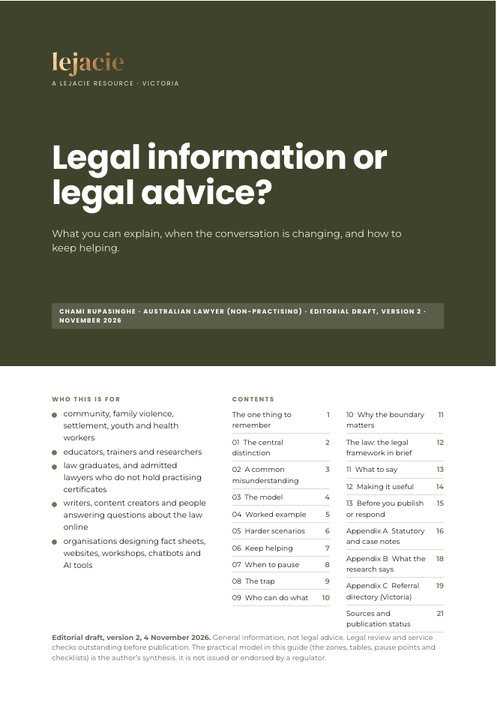 Legal information or legal advice? A guide for community and family violence workersLejacie guide · PDFOpen
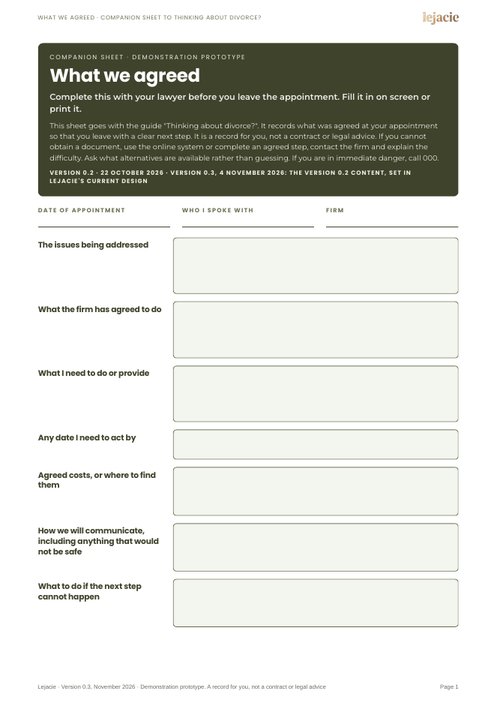 What we agreed: a companion sheet for recording what was discussed and what happens nextLejacie tool · PDFOpen
- Maya’s pathway: what gets lost when context is not sharedLejacie case study
- Information sharing under FVISS and CISS, what staff can share and how to record itTraining
- Victorian Government: Family Violence Information Sharing SchemeExternal link
- Victorian Government: Child Information Sharing SchemeExternal link
Relevant learning
Lejacie sessions for this area, shaped to your team:

Events from across the sectors

Workshops, webinars and recordings from other organisations, in the “Working across services” area of our events collection.
What’s changing
- Not yet in effectPrivacy policies must disclose automated decisions
Organisations covered by the Privacy Act will need to say in their privacy policy when personal information is used in automated decisions that significantly affect people.
- In effectChild safety reporting has moved to the Social Services Regulator
Reportable conduct notifications now go to the Social Services Regulator. The information sharing obligations themselves are unchanged.
All updates, with sources and review dates, are in What’s changing.
Areas we cover
- Confidentiality and when it can be set aside.
- Consent to share: what it covers, when it is not needed, and how to explain it.
- The Family Violence Information Sharing Scheme and the Child Information Sharing Scheme, and who is a prescribed entity.
- Recordkeeping: what to write down, what not to, and who can see it.
- Handovers and referrals that carry the context that matters without over-sharing.
- Privacy obligations for organisations, including automated decisions and tools.
What we can develop for this area: Consent scripts, sharing decision guides, recordkeeping checklists, handover templates and team scenarios.
Sources and frameworks we draw on
- Family Violence Protection Act 2008 (Vic), Part 5A (Family Violence Information Sharing Scheme) and its Ministerial Guidelines
- Child Wellbeing and Safety Act 2005 (Vic), Part 6A (Child Information Sharing Scheme)
- Privacy and Data Protection Act 2014 (Vic) and Health Records Act 2001 (Vic)
- Privacy Act 1988 (Cth) and the Australian Privacy Principles
- MARAM practice guides on information sharing and risk assessment
Official guidance and resources you can open now
Selected from the regulators, courts and organisations that publish the primary material for this area. Links checked 2 November 2026.
Resources
- Information Privacy Principles short guide (Office of the Victorian Information Commissioner (OVIC)). The 10 IPPs that bind Victorian public sector bodies and councils
- Guidance for sharing personal information (OVIC). How IPP 2 (use and disclosure) applies to sharing
- MARAM and information sharing guides (Family Safety Victoria). Ministerial guidelines for FVISS and CISS, with worked examples
- CISS and Child Protection (Child Protection Manual (DFFH)). How CISS works alongside child protection
- Family Violence Information Sharing Scheme reviews (vic.gov.au). Two-year and five-year independent reviews and government responses
- Children's Online Privacy Code (OAIC). Who the new code binds and the timeline
- Privacy for Kids hub (OAIC). Child-friendly guides, workbooks and lesson plans on online privacy, ready for community education
Learning from other organisations
- OVIC privacy resources and webinars for public sector organisations (OVIC says it is updating its guidance as of September 2026).
- OAIC lesson plans for educators from the Privacy for Kids hub, which fit Clear communication as well.
Recent developments
Reported changes we are tracking for this area. Full entries with status and review dates appear in What’s changing once reviewed.
OAIC must register the Children's Online Privacy Code. It will bind social media, messaging, gaming and other online services likely to be used by children. Source: OAIC
Attorney-General released draft "tranche 2" Privacy Act reforms: a fair and reasonable test, a right to erasure from large platforms, stronger consent standards, and limits on trading personal information. Consultation closed 18 September 2026; law firms expect commencement in 2027. Source: Attorney-General media release
Public consultation on the draft Children's Online Privacy Code, including 425 responses from children, young people and carers. Source: OAIC
Statutory tort for serious invasions of privacy commenced, giving individuals a right to sue. Source: Privacy and Other Legislation Amendment Act 2024 (Cth), Schedule 2
Legislation and primary sources
- Privacy and Data Protection Act 2014 (Vic) and the Health Records Act 2001 (Vic).
- Privacy Act 1988 (Cth) and the Privacy and Other Legislation Amendment Act 2024 (Cth).
- Family Violence Protection Act 2008 (Vic), Part 5A (FVISS); Child Wellbeing and Safety Act 2005 (Vic), Part 6A (CISS).
- Privacy reform consultation hub (Attorney-General's Department).
- Related topics: Safety and safeguarding, Responsible AI (automated decisions), Clear communication (explaining consent to share).