

Responsible AI and professional judgement
“AI helped produce this. What do I need to check?”
Explore verification, source checking, privacy and responsibility for information you rely on or share.

What this means in practice
A fluent answer is not the same as a reliable one. Professionals still need to examine the sources, protect sensitive information and decide what they can responsibly use or share.
We develop practical resources for AI-assisted work, with attention to verification, professional judgement and the person who may rely on the result.
Resources and learning you can open now
- Responsible AI: resources and training, by audienceAlgorithmic bias, privacy, verification, human judgement, accountability
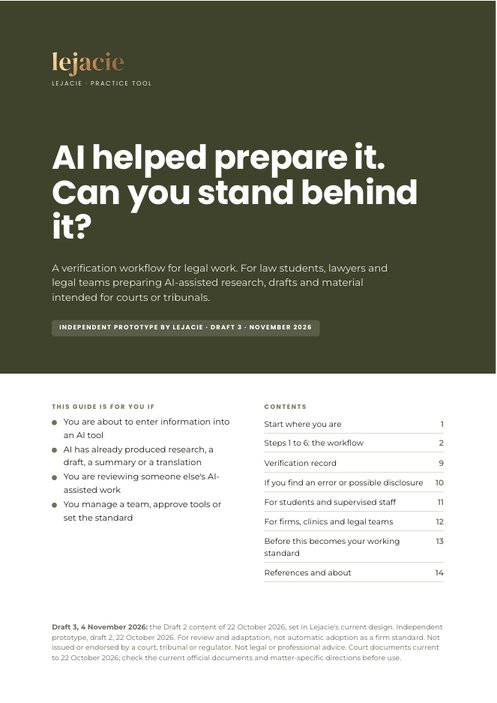 AI helped prepare it. Can you stand behind it?Lejacie practice tool · PDFOpen
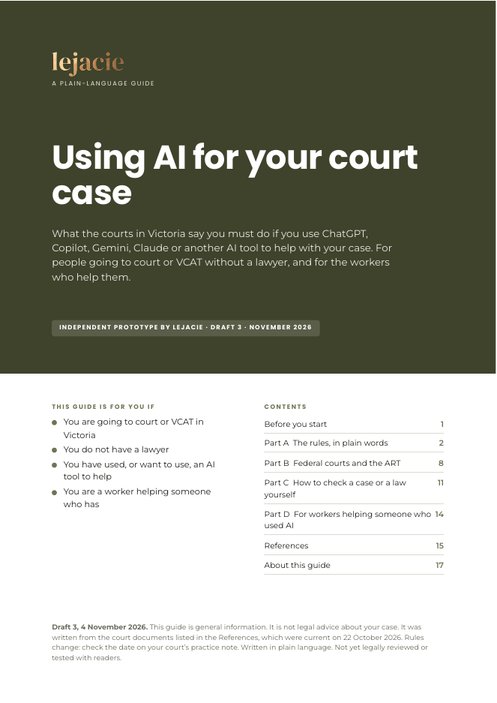 Using AI for your court caseLejacie guide · PDFOpen
- Supreme Court of Victoria: Practice Note SC GEN 25External link
- Responsible AI for legal and human services teamsTraining
Relevant learning
Lejacie sessions for this area, shaped to your team:
Events from across the sectors

Workshops, webinars and recordings from other organisations, in the “Ethics, reflection and AI” area of our events collection.
Not-for-profits are using AI faster than they are writing the rules for it.
Source: Infoxchange, 2025
What’s changing
- In effectCourts now have rules for AI in documents
The Supreme Court of Victoria issued Practice Note SC GEN 25, Use of Artificial Intelligence by Court Users, and the Federal Court issued its Generative AI Practice Note. Both set out when AI use must be disclosed and what a person filing a document is responsible for.
Who it affects: Lawyers and legal teams, and anyone representing themselves, including the community workers helping them prepare.
What to consider: Verification before anything AI-assisted is filed, disclosure where the court requires it, and what you tell a client who has used ChatGPT to draft their own affidavit. Check the practice note for the specific court and list you are in.
Supreme Court of Victoria: Practice Note SC GEN 25 · AI helped prepare it. Can you stand behind it? · Using AI for your court case · Full entry
- Not yet in effectPrivacy policies must disclose automated decisions
Under the Privacy and Other Legislation Amendment Act 2024, organisations covered by the Privacy Act 1988 must say in their privacy policy which decisions are made or substantially assisted by automated systems, and what personal information those systems use.
Who it affects: Any service covered by the Privacy Act that uses AI or automated tools to triage, assess, prioritise or decide anything about a person, including not-for-profits over the turnover threshold and health service providers of any size.
What to consider: An audit of where automated tools touch decisions about people, a privacy policy that says so in plain language, and whether your organisation is covered at all.
Office of the Australian Information Commissioner · Training: responsible AI for legal and human services teams · Full entry
All updates, with sources and review dates, are in What’s changing.
Areas we cover
- Checking AI-assisted research, explanations and documents.
- Distinguishing source material, generated content and professional interpretation.
- Privacy, confidentiality and sensitive information.
- Professional supervision, accountability and review.
- Court, regulator and professional-body guidance.
- Explaining the role and limits of AI to clients and service users.
- Recognising when a task needs specialist review or human involvement.
What we can develop for this area: Verification workflows, review checklists, practice scenarios and team learning.
Sources and frameworks we draw on
- Supreme Court of Victoria Practice Note SC GEN 25, Use of Artificial Intelligence by Court Users
- County Court of Victoria AI guidelines and the Federal Court Generative AI Practice Note (2026)
- VLSB+C and Victorian Bar guidance on AI in legal practice
- Privacy Act 1988 (Cth) automated decision transparency rules, from 10 December 2026
- OVIC guidance on AI and privacy for Victorian public sector bodies
- The Australian Government’s Guidance for AI Adoption and the Voluntary AI Safety Standard
- Australia’s AI Ethics Principles
Official guidance and resources you can open now
Selected from the regulators, courts and organisations that publish the primary material for this area. Links checked 2 November 2026.
Resources
- SC GEN 25: The use of AI by Court users (Supreme Court of Victoria). Applies to lawyers, self-represented litigants, witnesses and experts
- Generative AI Practice Note (GPN-AI) (Federal Court of Australia). National court expectations, including verification
- Artificial Intelligence in Victoria's Courts and Tribunals report (Victorian Law Reform Commission). 30 recommendations; first Australian law reform inquiry on AI in courts
- Guidance for safe and responsible use of generative AI in the Victorian public sector (Victorian Government). Supports the mandatory Administrative Guideline, with example scenarios
- Use of enterprise generative AI tools in the Victorian public sector (OVIC (June 2026)). Minimum privacy and security expectations for councils and agencies
- LIV Artificial Intelligence Hub (Law Institute of Victoria). Resources and practice guidance for lawyers
- Be ready to show the court how you verified AI (Legal Practitioners' Liability Committee (July 2026)). Practical verification steps for lawyers under SC GEN 25
- Guidance on the ethical use of generative AI (Victorian Bar (August 2025)). For barristers
Learning from other organisations
- Your existing resources: Using AI for your court case; AI verification and relevant practice guidance (legal practice pathway).
- AI adoption in Victorian local government (APO, June 2026): the first sector-wide baseline, useful for a council-focused session.
Recent developments
Reported changes we are tracking for this area. Full entries with status and review dates appear in What’s changing once reviewed.
Remaining requirements of the Commonwealth Policy for the responsible use of AI in government take effect; the first new mandatory requirement began 15 June 2026. Source: DTA
Victorian public sector generative AI guidance updated. Source: vic.gov.au
New NDIS laws allow computer systems to automate some administrative actions, with a duty to publish where automation is used. Source: NDIS
Commonwealth funds a community legal centre AI pilot and AI capability uplift for legal assistance. Source: Attorney-General
OVIC sets minimum expectations for enterprise generative AI tools in the Victorian public sector. Source: OVIC
Supreme Court Practice Note SC GEN 25 commenced, governing AI use by everyone who files documents. Source: Supreme Court
Federal Court issued its Generative AI Practice Note (GPN-AI). Source: Federal Court
VLRC report on AI in Victoria's courts and tribunals tabled in Parliament. Source: VLRC
Legislation and primary sources
- Australia's AI Ethics Principles (Department of Industry, Science and Resources).
- County Court of Victoria AI guidance (reported by Hall & Wilcox in 2026; find the court's own page before linking).
- Related topics: Privacy and information sharing, Legal problems and getting help, Workplace safety (AI and work design).
Different topics. Connected in practice.







90% of Lawyers for Big Companies Use AI. 9% of Legal Aid Lawyers Do.
The 2026 Victorian Lawyer Census, Fair Work Commission research and NSW Ombudsman data, read together: adoption follows the clients lawyers serve, and the checking work lands on the legal assistance sector.