
Safety and safeguarding
“What should we notice, record or escalate?”
Explore child safety, family violence and safeguarding responsibilities, with attention to the person’s circumstances and your professional role.

What this means in practice
Professionals need to recognise concerns, understand their responsibilities and work with other services without losing the context that matters.
We develop resources and learning around child safety, family violence, confidentiality and information sharing, keeping the person’s safety and the boundaries of the worker’s role in view.
Resources and learning you can open now
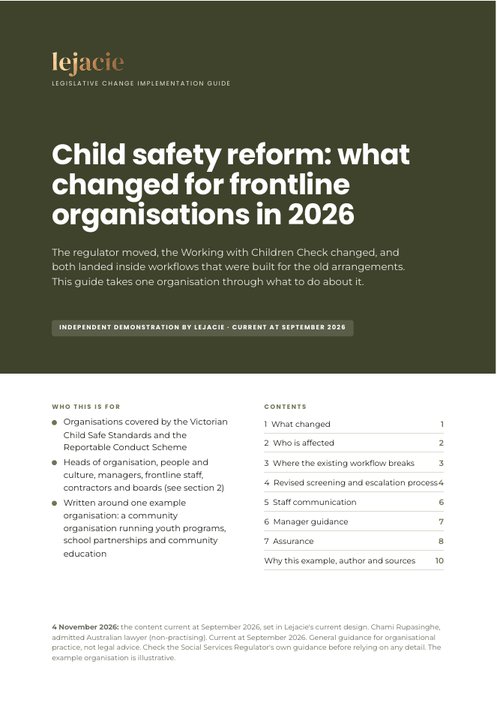 Child safety reform: what changed in 2026Lejacie guide · PDFOpen
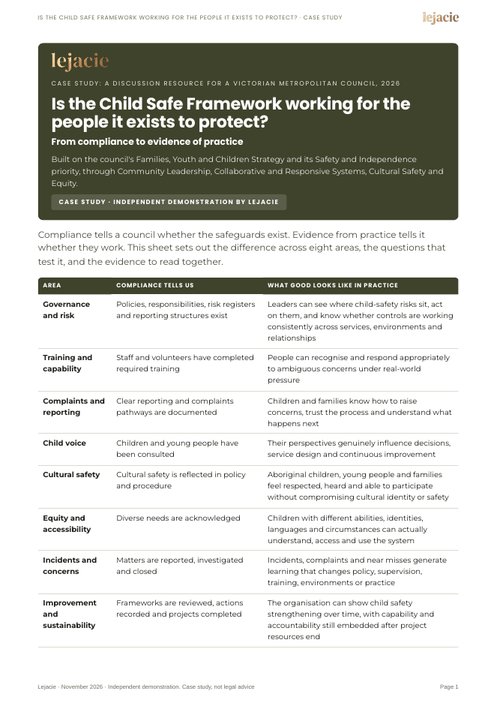 Is the Child Safe Framework working for the people it exists to protect?Lejacie case study · PDFOpen
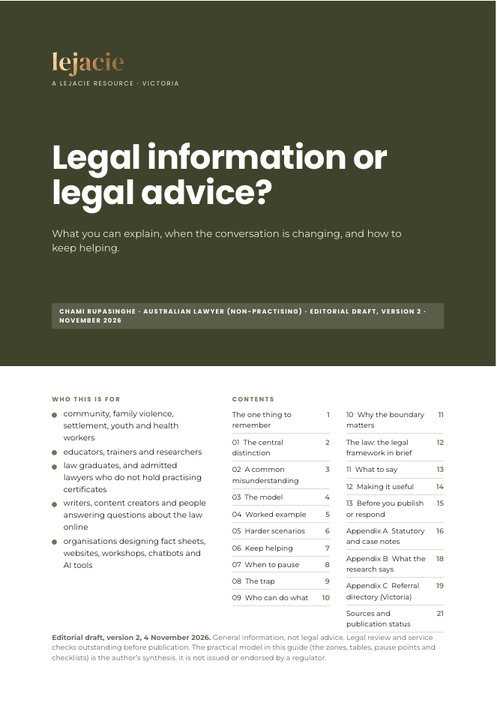 Legal information or legal advice?Lejacie guide · PDFOpen
- The Usable HandoverLejacie standard, on request
- Social Services Regulator (Victorian Government)External link
- Information sharing under FVISS and CISSTraining
Relevant learning
Lejacie sessions for this area, shaped to your team:

Events from across the sectors

Workshops, webinars and recordings from other organisations, in the “Rights, safety and decisions” area of our events collection.
What’s changing
- In effectChild safety reporting has moved to the Social Services Regulator
Responsibility for the Child Safe Standards and the Reportable Conduct Scheme moved from the Commission for Children and Young People to the Social Services Regulator. The obligations themselves stay in the Child Wellbeing and Safety Act 2005 (Vic) and are unchanged.
Who it affects: Every organisation covered by the Child Safe Standards or the Reportable Conduct Scheme: schools, early childhood services, councils, sport and recreation, community services, religious bodies, health services.
What to consider: Where reportable conduct notifications go, who you ask for guidance, and the name in your child safety policy, induction and posters. Check the Regulator’s current notification form and timeframes rather than old templates.
Victorian Government: New reforms strengthen child safety · Child safety reform: what changed in 2026 · Full entry
- Passed Parliament · Not yet in forceVictoria has passed laws to create a standalone coercive control offence
The Justice Legislation Amendment (Family Violence, Coercive Control, Good Character, Risk Assessment and Other Matters) Act 2026 creates a standalone offence of coercive control, alongside changes to good character evidence and risk assessment, and makes “subjection to family violence” a protected attribute under the Equal Opportunity Act.
Who it affects: Family violence and community workers, police, courts, legal teams, and employers once the Equal Opportunity change commences.
What to consider: The offence does not apply until it commences. Coercive control is already recognised as family violence for intervention orders and under MARAM, so the practice question now is how you recognise and record it, and how you explain the difference between existing protections and the new offence.
VCOSS: response to the family violence reforms (August 2026) · When the legal process becomes part of the abuse · Follow Maya’s pathway · Full entry
All updates, with sources and review dates, are in What’s changing.
Areas we cover
- Child Safe Standards, reportable conduct and child-safe organisational practice.
- Screening requirements and safeguarding responsibilities.
- Recognising and responding to family violence, including patterns of coercive control.
- MARAM, the Family Violence Information Sharing Scheme and the Child Information Sharing Scheme.
- Privacy, confidentiality, recordkeeping and information handling.
- Referrals and handovers: what the next professional needs to understand.
- Changes to safeguarding requirements and their implications for practice.
What we can develop for this area: Practice guides, worked scenarios, recording prompts, reflective activities and team learning.
Sources and frameworks we draw on
- Child Safe Standards and the Reportable Conduct Scheme under the Child Wellbeing and Safety Act 2005 (Vic), now regulated by the Social Services Regulator
- National Principles for Child Safe Organisations
- Working with Children Check and the Worker Screening Act 2020 (Vic)
- Education and Care Services National Law and the Victorian Early Childhood Regulatory Authority (VECRA)
- MARAM and the Family Violence Protection Act 2008 (Vic)
- Family Violence Information Sharing Scheme (FVISS) and Child Information Sharing Scheme (CISS)
- Children, Youth and Families Act 2005 (Vic)
- Privacy and Data Protection Act 2014 (Vic) and Health Records Act 2001 (Vic)
- Coercive control: recognised under MARAM now; proposed offence in the Justice Legislation Amendment (Family Violence, Coercive Control, Good Character, Risk Assessment and Other Matters) Bill 2026 (Vic)
Official guidance and resources you can open now
Selected from the regulators, courts and organisations that publish the primary material for this area. Links checked 2 November 2026.
Resources
- Short guide to the Child Safe Standards (Social Services Regulator (vic.gov.au)). Plain overview of the 11 Victorian standards
- Complying with the Child Safe Standards (Social Services Regulator). What organisations must do, standard by standard
- Child Safe Standards hub (Social Services Regulator). Landing page, now the main source since the move from CCYP
- Reportable Conduct Scheme (Social Services Regulator). Who must notify, what is reportable, timeframes
- The Social Services Regulator's powers (Social Services Regulator). What the regulator can now do
- MARAM practice guides and resources (Family Safety Victoria). Family violence risk identification, assessment and management by role
- National Principles for Child Safe Organisations (National Office for Child Safety). National baseline, useful for cross-border organisations
- Child Safe Standards for education providers (VRQA). Sector-specific version for schools and training providers
Learning from other organisations
- National child safety training (foundation modules) for early childhood staff, developed by the Australian Centre for Child Protection: due by 27 August 2026 (details).
- PROTECT: Mandatory Reporting and Other Obligations, the Department of Education's online module, now an annual requirement for Victorian early childhood staff working directly with children.
- MARAM practice guide videos and the updated Responding to Family Violence Capability Framework (DFFH, December 2025).
Recent developments
Reported changes we are tracking for this area. Full entries with status and review dates appear in What’s changing once reviewed.
WWC Connect launched: organisations, including sole traders, must notify the SSR of workers and volunteers they engage, and verify them through the new online system. Mandatory child safety training starts for WWC applicants and renewals. Source: vic.gov.au
WWC reforms: stronger information sharing between child safeguarding regulators, changes to appeals against adverse WWC decisions, and to how eligibility is assessed. Source: vic.gov.au
Early childhood providers must record staff and volunteers in the National Early Childhood Worker Register, replacing the Victorian register. Source: vic.gov.au
Children's safety, rights and best interests become the paramount consideration for all decision-makers in early childhood education and care. Source: vic.gov.au
Seventh annual report on implementing the MARAM Framework released. Source: vic.gov.au MARAM
Legislation and primary sources
- Child Wellbeing and Safety Act 2005 (Vic): home of the Child Safe Standards and Reportable Conduct Scheme.
- Worker Screening Act 2020 (Vic) and the Social Services Regulation Amendment (Child Safety, Complaints and Worker Regulation) Act 2025.
- Education and Care Services National Law, as amended in 2025 and 2026.
- Related topics: Privacy and information sharing (FVISS, CISS), Workplace safety (vicarious trauma), Research into practice ("Is the Child Safe Framework working?").