
You have the knowledge. Let’s make it useful.
Your research needs to reach practitioners. Your team needs to apply new guidance. The people you support need a clearer explanation.
We work with you to understand what people need to know or do, what gets in their way, and how a resource or learning activity could help. Then we develop the guides, tools, briefs or learning materials around that purpose.
Bring us a defined piece of work, or involve us in a wider research, education or service project. You don’t need to arrive with a format in mind.

Free to read. Paid to apply.
Our guides, research summaries and core tools are free to access. If you need help applying them to your organisation, reviewing your information, developing resources or learning with your team, you can work with us. Organisations can also commission resources that are published free for the people who need them.
The boundary is specificity, not usefulness. A free resource solves a real problem for anyone. Paid work addresses your organisation’s particular material, people, circumstances and implementation needs. Paid work is what funds the free library.
Information review
“Apply your approach to our website, guides or resources.”
An agreed set of pages or resources, interviews to understand the professional context, specific findings with annotated examples, prioritised recommendations and the questions that need specialist review.
Expertise capture and resource development
“Help us turn what our people know into something useful.”
Structured interviews, research and source synthesis, writing and designing the resource, coordinating review, testing and handover.
Research translation is a specialism within this. Research to Real Life is its fixed-fee form for individual researchers.
Professional learning
“Help our people develop the understanding and judgement to use this.”
A private team briefing, a tailored scenario-based workshop, a learning series, or a facilitated session to test a resource or a handover with the people who will use it.
What we do not sell
- Approval that a tool, resource or organisation is compliant, unbiased or safe. We sell defined work and deliverables.
- Legal, clinical or regulatory conclusions. We identify communication problems and the questions needing specialist attention.
- Access to public information. Everything on this site stays free; what you pay for is the work of producing something fit for your purpose.
Community organisations that cannot meet a fee can ask about concessions or a limited pro bono allocation each year. These are deliberate decisions, made case by case.
What are you working on?
Open the one that sounds like yours. Each shows what you’re trying to achieve, how Lejacie can contribute and what we could develop, with an example clearly labelled as commissioned work or an independent demonstration.
What you’re trying to achieve
Publishing the findings is one step. Helping someone understand what they mean for a service, a conversation or a decision is another.
How Lejacie can contribute
We work with you to identify who could use the research, what they need from it and which formats could support that use. We keep the study’s findings and limitations distinct from suggested applications and practice questions.
What we could develop
- Practice and policy briefs.
- Plain-language summaries.
- Tools and discussion activities for teams.
- Teaching and learning materials.
See an independent demonstration
One published study on post-separation coercive control, developed into four resources: a public summary, a practice brief, a team activity and a policy brief.
These are demonstration resources, not a commissioned project or an endorsement by the researchers.
Working with one published study? Explore Research to Real Life, a fixed-fee package for individual researchers.
What you’re trying to achieve
A client needs to understand what happens next. A colleague needs to explain a process consistently. A referral partner needs to know when and how to connect someone with your service.
How Lejacie can contribute
We work out where people are getting stuck and what they need at that point, then develop resources for both sides of the conversation: the professional explaining it and the person trying to make sense of it.
What we could develop
- Client guides and plain-language explanations.
- Conversation tools and appointment companions.
- Referral resources for partner services.
- Lesson plans and facilitator materials.
Independent demonstrations
Resources Lejacie developed independently, as examples of the formats.
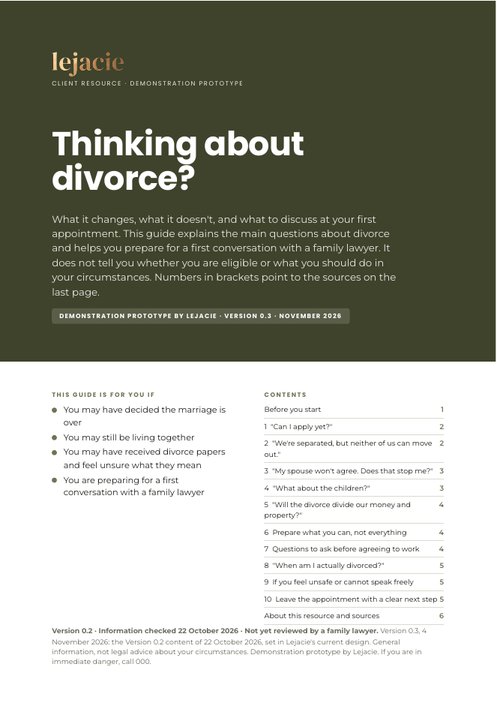 Thinking about divorce?A plain-language resource for a client preparing to speak with a family lawyer.Open the client guide
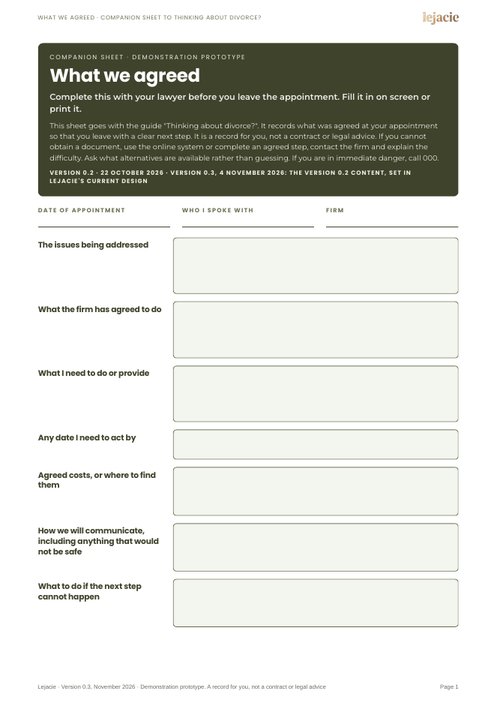 What we agreedA companion sheet to help someone leave an appointment understanding the discussion, responsibilities and next steps.Open the companion sheet
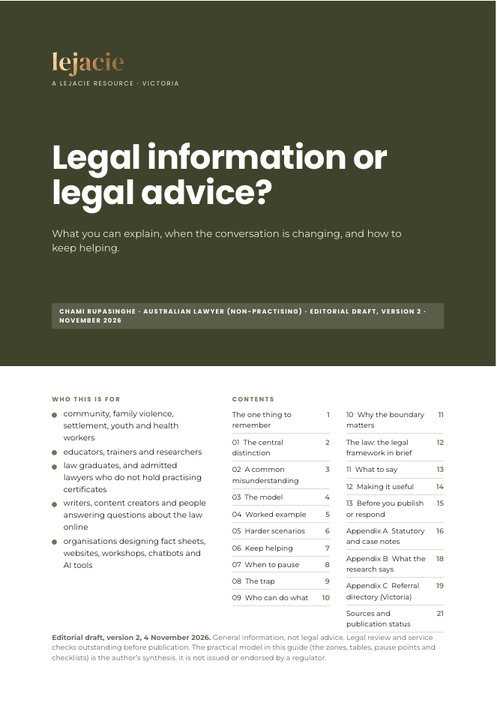 Legal information or legal advice?A guide for community and family violence workers considering the boundaries of their role when responding to legal questions.Open the guide
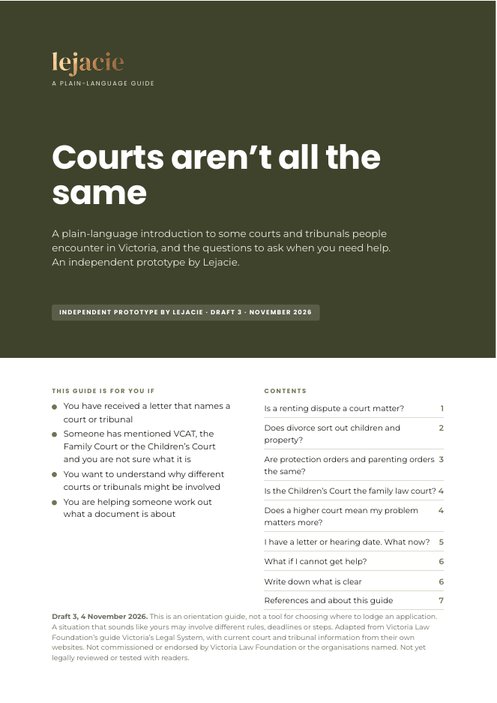 Courts aren’t all the sameA plain-language guide to help someone make sense of the court named in their letter.Open the guide
What you’re trying to achieve
Publishing a policy and putting it into practice are different tasks. Your people need to understand what has changed, what it means for their roles and what to consider in the situations they encounter. They may also need to explain those changes to others.
How Lejacie can contribute
We work from agreed sources and relevant legal or specialist input to identify what each role needs to understand and do, then develop resources and learning around those needs.
What we could develop
- Change briefings and practice guides.
- Worked scenarios and practical tools.
- Induction materials.
- Reflective practice and team learning.
Independent demonstrations
Resources Lejacie developed independently, as examples of the formats.
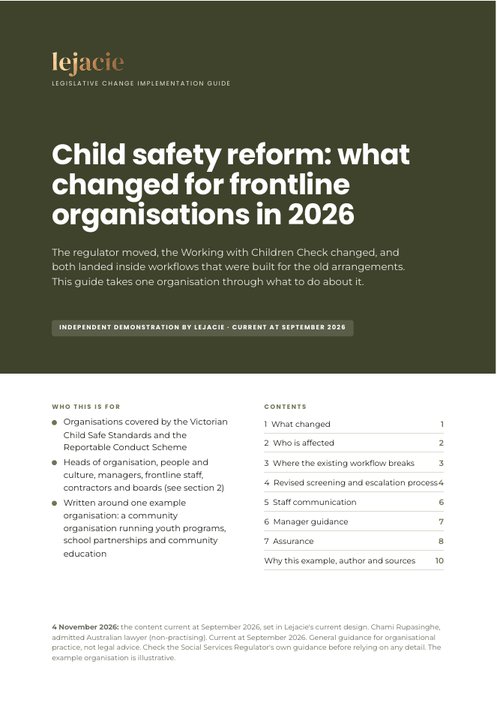 Child safety reform: what changed in 2026An implementation guide for frontline organisations making sense of changes and their implications for practice.Open the guide
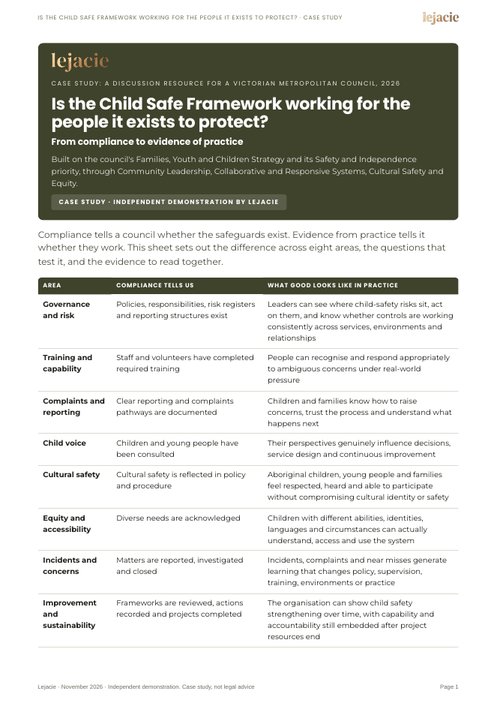 Is the Child Safe Framework working for the people it exists to protect?A case study examining the relationship between a framework, organisational practice and the people it is intended to protect.Open the case study
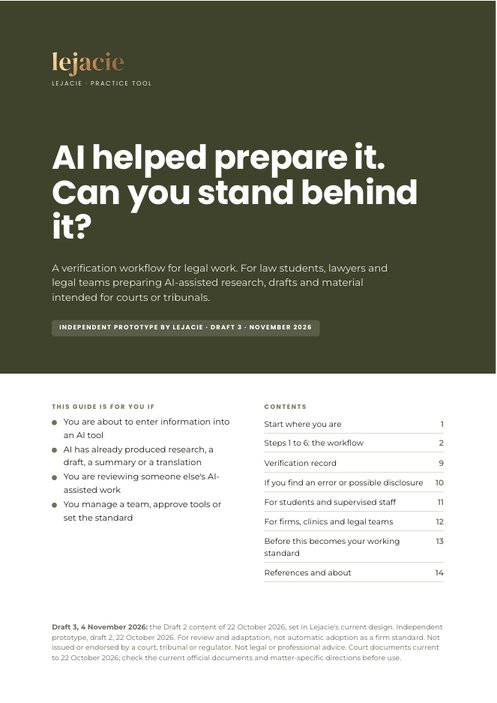 AI helped prepare it. Can you stand behind it?A verification workflow for law students, lawyers and legal teams reviewing AI-assisted work.Open the practice tool
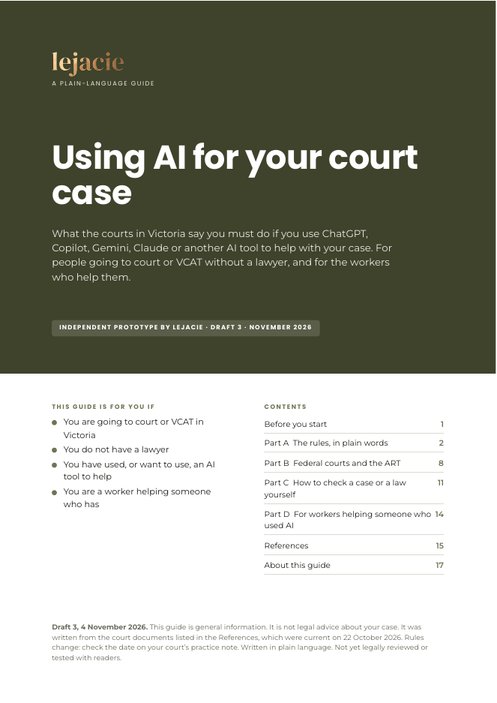 Using AI for your court caseA plain-language guide for people going to court without a lawyer, and a resource professionals can share.Open the guide
What you’re trying to achieve
The project plan promises a toolkit, guide or learning package. Your team holds the knowledge, but developing the resources needs time, structure and a clear understanding of who will use them.
How Lejacie can contribute
We work with you to turn the agreed scope into materials people can use, with review and approval arrangements established at the start. We can contribute a defined piece of work or work alongside your team across the project.
What we could develop
- Resource collections and practical guides.
- Tools, lesson plans and facilitator packs.
- Public-facing information.
Examples of the formats
- Legal information or legal advice?A focused guide addressing a recurring question for a defined professional audience.Explore the guide
- Child safety reform: what changed in 2026An example of translating complex changes into a practical resource for frontline organisations.Explore the implementation guide
These are independent demonstrations of possible formats, not resources produced under a funded commission.
What you’re trying to achieve
A conference, forum, training day or roundtable can generate findings, questions and practical insights that deserve more than a set of slides.
How Lejacie can contribute
We help capture the knowledge and develop resources for the people who attended, the teams they return to and the people who could not be there.
What we could develop
- Conference syntheses and audience-specific briefs.
- Discussion guides and reflective activities.
- Lesson plans and follow-up learning.
Independent demonstrations
Resources Lejacie developed independently, as examples of the formats.
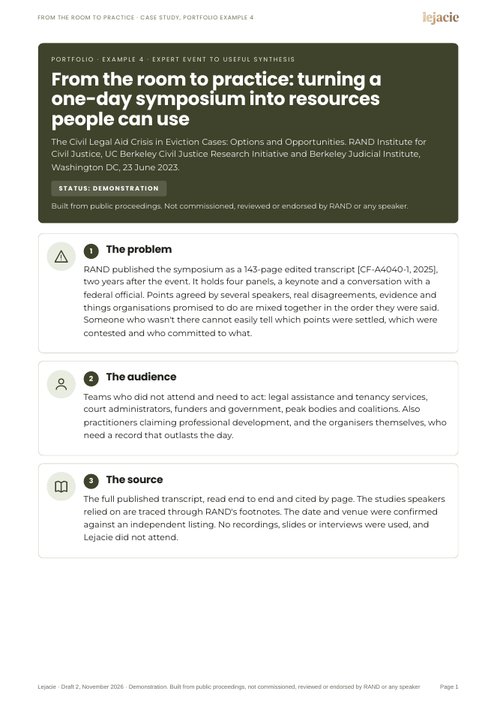 From the room to practiceA conference synthesis designed to make the discussion useful beyond the room.Open the synthesis
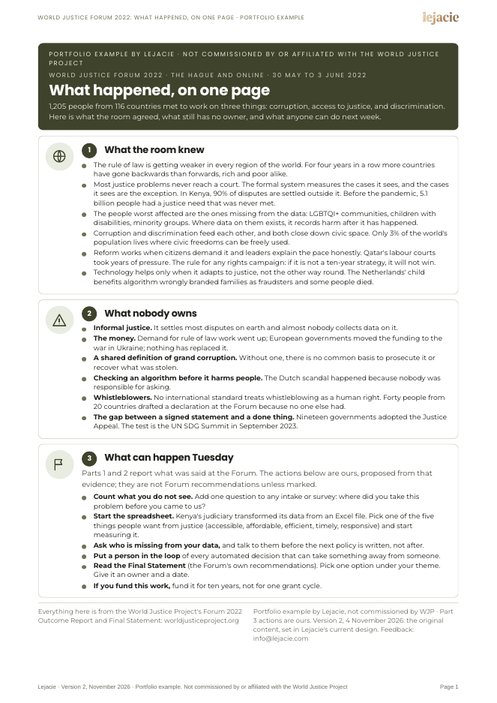 World Justice Forum 2022: one forum, six audiencesA portfolio showing how one event can be translated for different audiences and purposes.Open the portfolio
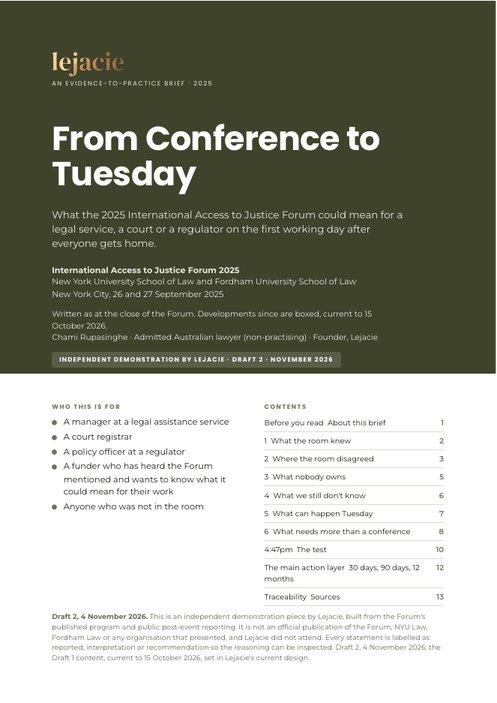 From Conference to TuesdayAn evidence-to-practice brief focused on what someone can take back to their work.Open the brief

How working together starts
- Tell us what you’re trying to do. Who is it for? What do they need to understand or do? What already exists? A few lines are enough to start.
- We discuss where we can help. We respond within five working days to let you know whether the project looks like a fit and what we need to understand before proposing the work.
- We agree the scope and fee. Before work begins, we agree the deliverables, timing, fee, review stages and any legal or specialist input needed. Tell us your timeframe and budget so we can discuss a realistic scope.
- We develop and review the work. We develop the agreed materials with your input, checking them against the intended purpose and incorporating feedback at the agreed stages. We agree review responsibilities and how the finished materials can be used.
Scope, deliverables and relevant legal or specialist review arrangements are agreed for each project. See our terms of engagement.
Built around the people who will use it
We start from existing evidence, your team’s knowledge of the people you work with, and any consultation agreed as part of the project.
Where appropriate, we can include feedback from the people who will use the resource, such as practitioners, clients or community members, with the approach agreed as part of the project.
The aim is not simply to turn your knowledge into a polished document. It is to work out what people need, then develop something for that use.
Lejacie provides education and resource development, not individual legal advice or representation.