
Research
We like questions that get more interesting the closer you look.
Lejacie studies what happens when law, policy, research, technology and professional expertise meet real life.
Sometimes we start with a person who cannot use something that technically exists.
Sometimes with a professional decision that looks simple until you get close to it.
Sometimes with a reform that has passed, a technology everyone is arguing about, or an outcome that should not keep happening, but does.
The question is rarely just what happened?
We want to know:
- Why did it happen?
- What keeps producing it?
- Who is quietly doing the work of compensating for it?
- Have we been naming the wrong problem?
- What would have to change for the ending to be different?
We research what is actually happening after law, policy and research leave the page, and whether it actually works for the people it was meant for.
We translate it into what practitioners can actually do on a Tuesday, so it doesn’t stay stuck.
We investigate the distance between what a law, policy, resource or reform is supposed to do and what people and professionals experience in real life.
We look for the moment where relevance, meaning, trust, judgement, action or continuity disappears.
Usually asked:
Was the information published?
We ask:
But could the person use it when it mattered?
This is After the Law, our research series, and LegalLens, our practice intelligence.
The question underneath everything
What happens to important expertise between the person or institution that knows something and the person who actually has to use it?
Everything Lejacie does sits somewhere along this path:
Expertise → Rule, research, policy or professional knowledge → Resource or system → Professional → Person → Action → Outcome
We look at it from different directions.
After the Law looks from the system toward the person. What happens after law, policy, research, regulation or institutional design leaves the page and encounters real life?
Professionals From the Future looks at the professional in the middle. As information, technology and expectations change, what does professional expertise need to become?
LegalLens looks at the environment around both. What just happened in law, research, regulation or professional practice that is actually worth noticing?
Reports investigate deeply. Methods are how Lejacie solves the problem. Resources are something people can use. Commissions apply the capability for clients.
LegalLens notices. After the Law and Professionals From the Future ask. Reports test. Methods generalise. Resources make usable. Commissions apply.
After the Law
The law passed. The policy was published. The report landed. What happened next?
After the Law follows law, policy, inquiry findings, reforms and public protections beyond publication.
A reform can be legally sound and still fail to become usable.
A right can exist while the person it was designed for cannot recognise it, trust the pathway around it or act on it.
A service can be technically coordinated while the person still has to make all the pieces connect.
So we follow the promise beyond the page.
We ask:
- Who was this meant to help?
- What did they actually have to understand or do?
- What did professionals have to interpret?
- Where did the pathway break?
- Who carried the hidden burden?
- What would make the original promise real?
After the Law is about the distance between paper law and lived law.
Published

Family violence · Service coordination
She Told Her Story Six Times. Every Service Was “Coordinated.”

Family violence · Reform and outcomes
Australia Spent More Than $4 Billion on Domestic Violence Reform. More Women Are Being Killed Than in a Decade.
Family law · Courts
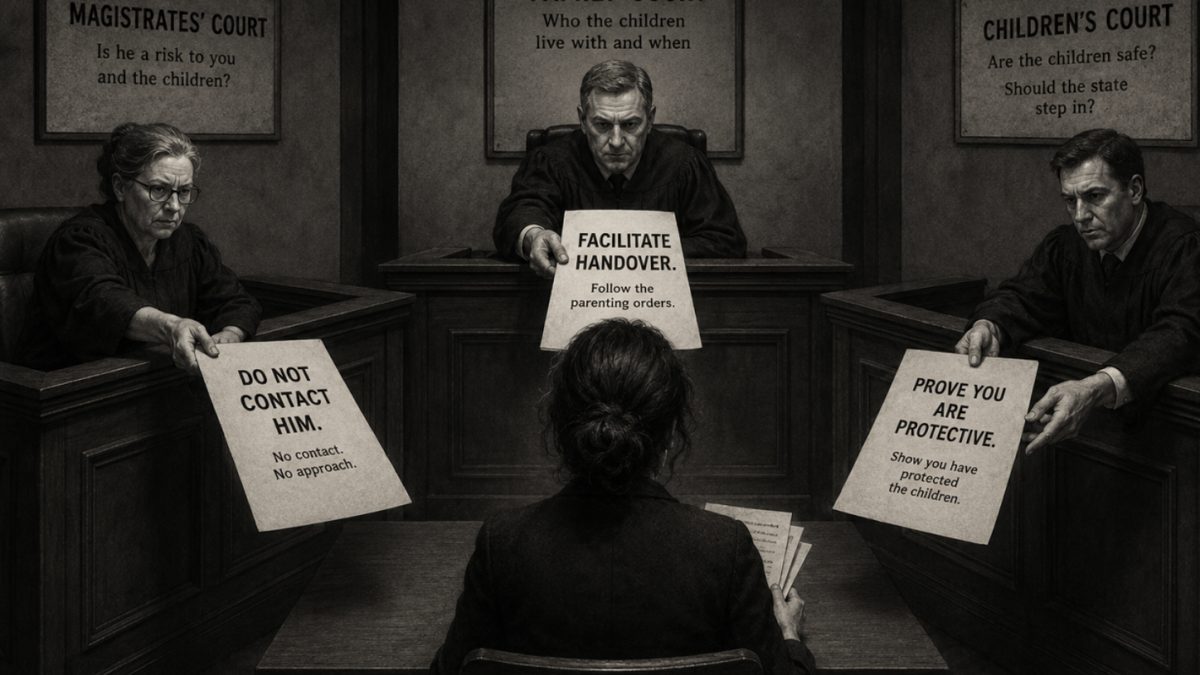
She Left. Now She’s in Three Courts, and She Wants Out of Those Too.

Law and usability
The Law Was Written to Be Followed, Not Understood (And Plain English Isn’t Going to Fix That)

AI · Courts and self-represented litigants
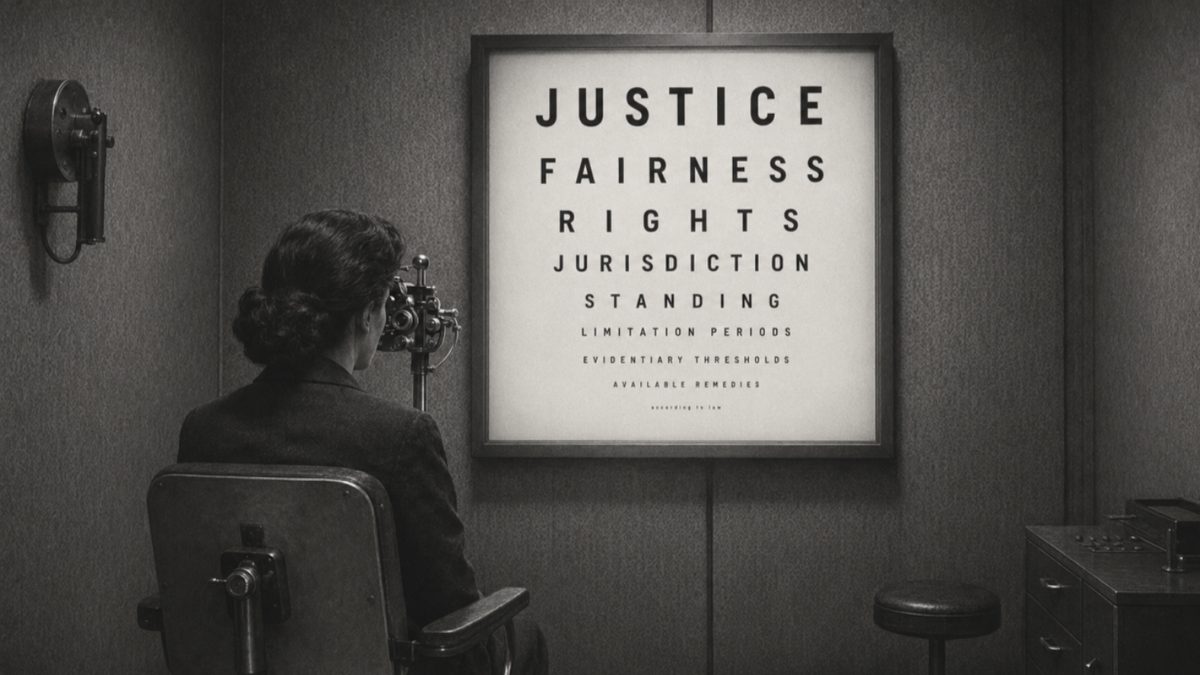
She Couldn’t Afford a Lawyer. The Court Punished Her for Using AI.
AI · Public legal understanding
AI Is Hallucinating the Justice System We Told People Exists
Next in the series
- The Letter Was Correct. She Still Missed the Deadline. Where does responsibility for communication end?
- The Careful AI Went to the People Who Already Had Lawyers. If legal AI can increase access, who is actually receiving its benefits?
- It Was 11:43pm. The AI Told Her to Speak to a Lawyer. What responsibility does an information system have when it reaches the edge of what it can safely do?
- She Called the Police for Help. They Listed Her as the Perpetrator. What happens after the first institution gets you wrong?
- The Law Is Written for the Person You Are Least Likely to Be When You Need It. Who is the human our systems implicitly assume will use them?
- Australia Is Spending $3.9 Billion on Access to Justice. How Will We Know If Justice Became More Accessible? What counts as success?
- We Keep Asking If AI Is Biased. We Should Be Asking the Same of Ourselves. What is the benchmark?
- The Law People Were Looking For. A Lejacie report. What do hallucinated legal authorities reveal about the justice people expect to exist?
Professionals From the Future
We look for people already practising the future of their field.
The future of a profession rarely arrives all at once.
Usually, somebody notices that an old assumption no longer holds.
A lawyer changes how expertise reaches clients.
A researcher redesigns how evidence travels.
A public servant builds a different way of implementing policy.
A technologist finds a task machines can do, and a form of judgement they cannot.
An educator realises the curriculum is preparing people for a profession that is already changing.
Professionals From the Future looks across those experiments. It is research-led: we investigate what is changing about professional work, then report what we found.
Published
Next in the series
Working titles. Each is research-led: we say “we looked at” only where we have done the looking.
- We Looked at What People With Law Degrees Actually Do With Difficult Problems. There Are 11 Types. How do you create value?
- We Mapped the Careers You Can Build With a Law Degree. There Are 13 Paths Nobody Shows You. Where can your kind of contribution actually go?
- We Looked at 1,000 Australian Legal Jobs. These Are the Skills Employers Actually Want. What capabilities are employers actually buying?
- We Looked for Australian Jobs That Use Legal Expertise Without Being Traditional Legal Practice. Here’s What We Found. Where is legal expertise being deployed?
- The Law Lawyers Stopped Checking. A Lejacie report. What Australian AI failures reveal about verification, supervision and professional judgement.
- We Looked at What Lawyers Still Need to Know When AI Can Produce the Answer. These Are the Skills That Become More Important. If production becomes cheaper, what remains distinctly professional?
- We Looked at What People Can Now Do Without a Professional. These Are the Things Expertise Is Becoming More Valuable For. What is expertise worth when information becomes abundant?
- AI Is Supposed to Save Lawyers Time. We Looked at Where That Time Is Actually Going. Does productivity become reduced workload, cheaper services, more output, higher targets or simply different work?
- We Looked at What Happens When Clients Use AI Before They See a Lawyer. Here’s What Lawyers Need to Do Differently. What changes when the professional relationship starts from a different point?
Take the Professional Archetypes Quiz
Future Professional Conversations
Future Professional Conversations is the interview format inside Professionals From the Future.
These are conversations with people already practising differently. Not because they have a perfect prediction of the future, but because their work gives us something concrete to examine.
We ask:
- What problem do you work on?
- What does the work actually require?
- What weren’t you trained for?
- What capability matters more than people realise?
- What is changing?
- What should the next generation understand?
Over time, the conversations become evidence for the larger question:
What should the professions we rely on become next?
LegalLens
What just happened that is actually worth noticing?
Law changes.
Regulation changes.
Research changes.
Professional standards change.
Court decisions change what people need to pay attention to.
AI changes the conditions around the work before anyone has finished writing the guidance.
Professionals do not need another pile of links.
LegalLens is Lejacie’s practice-intelligence publication. It tracks law, regulation, policy, judgments, research, professional standards, AI and public expectations, and translates developments through: What changed? → Why does it matter? → What’s the practice question? → What should we watch next?
It is Lejacie’s fortnightly signal. The promise: I’ve read the judgments, reports, datasets, regulatory developments and research. These are the few things worth stopping for.
Each issue has four to six lenses. Each lens has four parts:
01 / The signal. What happened?
Why I’m stopping here. What’s interesting beneath the headline?
The practice question. What question should this create for people working in the field?
Watch next. What evidence or development would change the picture?
Because:
“Read the guidance” is not a workflow.
Example lens: AI benefits aren’t flowing evenly
The signal. Victorian research on generative AI use in the legal profession found that lawyers mostly see AI’s benefit as efficiency and productivity. Few saw affordability or accessibility as a benefit.
Why I’m stopping here. The access-to-justice promise of AI and its actual adoption pattern may be diverging.
The practice question. Who captures the productivity dividend from legal AI?
Watch next. Whether firms and services begin using AI for triage, unbundling, client translation and affordability.
Source: Victorian Legal Services Board + Commissioner, Generative AI Use in the Legal Profession (May 2026)
Reports
Investigating deeply.
A report is a format, not a separate brand. Each one follows the same structure: question, methodology, dataset, findings, limitations, implications.
Safe to Say, Safe to Reach, Safe to Use
Lejacie paper · Published 18 September 2026
A method for translating law, policy, research and professional expertise without losing what matters.
The Law People Were Looking For
After the Law · Report · In progress
What AI hallucinations can reveal about the justice people expect to exist. An analysis of hallucinated legal authorities used by self-represented people: what they were trying to establish, what remedy they believed should exist, and whether a real pathway existed.
The Law Lawyers Stopped Checking
Professionals From the Future · Report · In progress
What Australian AI failures reveal about verification, supervision and professional judgement.
Australian Legal Work
Professionals From the Future · Report · In progress
What Australian legal job advertisements reveal about changing professional capability.
How we investigate
Follow the contradiction until the outcome makes sense.
A service is “coordinated”, but the person tells their story six times.
Legal information is technically accessible, but the person still cannot work out what to do.
A protection exists, but the experience it was meant to change keeps happening.
Those contradictions are where Lejacie investigations begin.
We reconstruct what happened, test the obvious explanation, trace the conditions around the outcome, triangulate the evidence and look for the mechanism producing it.
We are particularly interested in the moment where the explanation flips:
We keep calling this X. But X may be the visible symptom. The underlying problem is Y.
The point is not to produce another diagnosis of what is broken.
It is to understand the problem well enough to design a different ending.
Future Professional Conversations
Nominate someone for Future Professional Conversations.
We are looking for people already practising the future of their field: people who noticed something about the traditional model was no longer working, and built, changed or tested an alternative. You can nominate someone else, or yourself.